


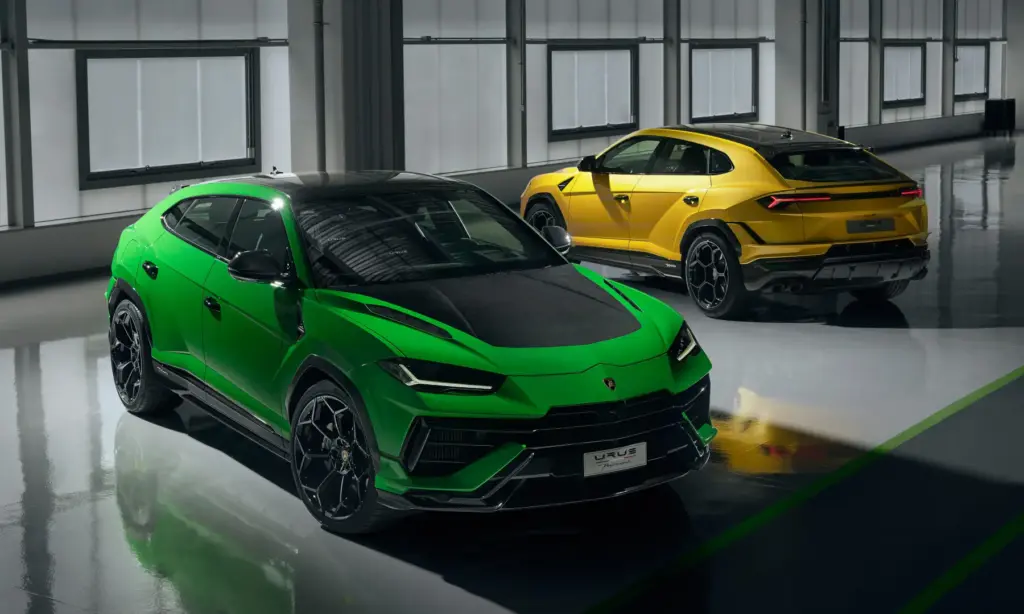

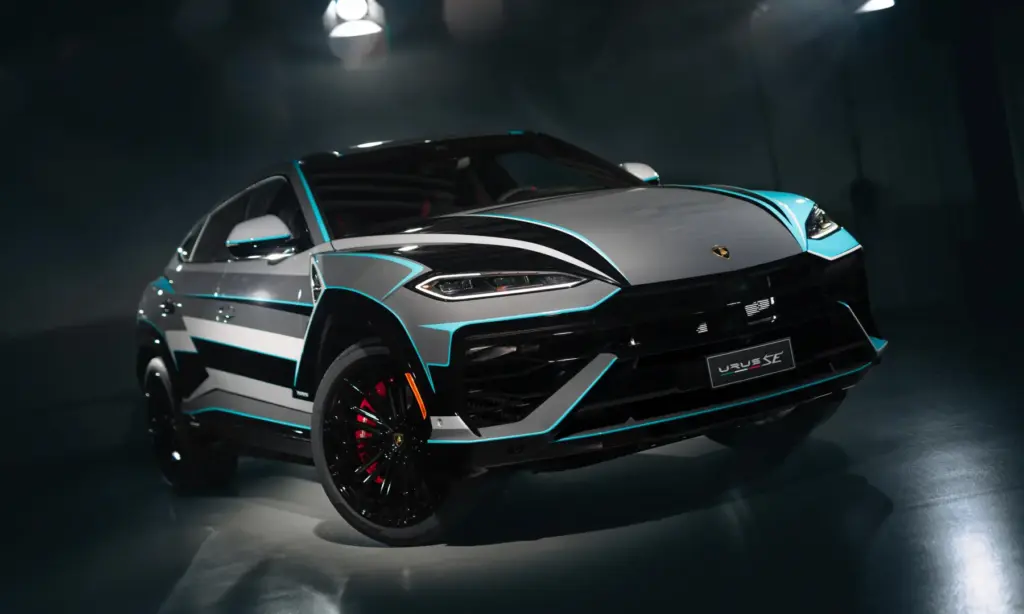

The idea of a Lamborghini SUV once sounded like a joke told at a Geneva stand, probably over espresso and disbelief. Yet here we are, nearly half a century later, with the Urus SE sitting at the sharp end of a line that began with a rear-engined military prototype and somehow ended with a plug-in hybrid Super SUV that can run silently, sprint hard, and still wear Sant’Agata’s badge with pride. That story arc only makes sense when you trace the missteps as closely as the wins. Lamborghini did not arrive in this segment by accident, nor did it get here by copying anyone else.
Cheetah and LM001
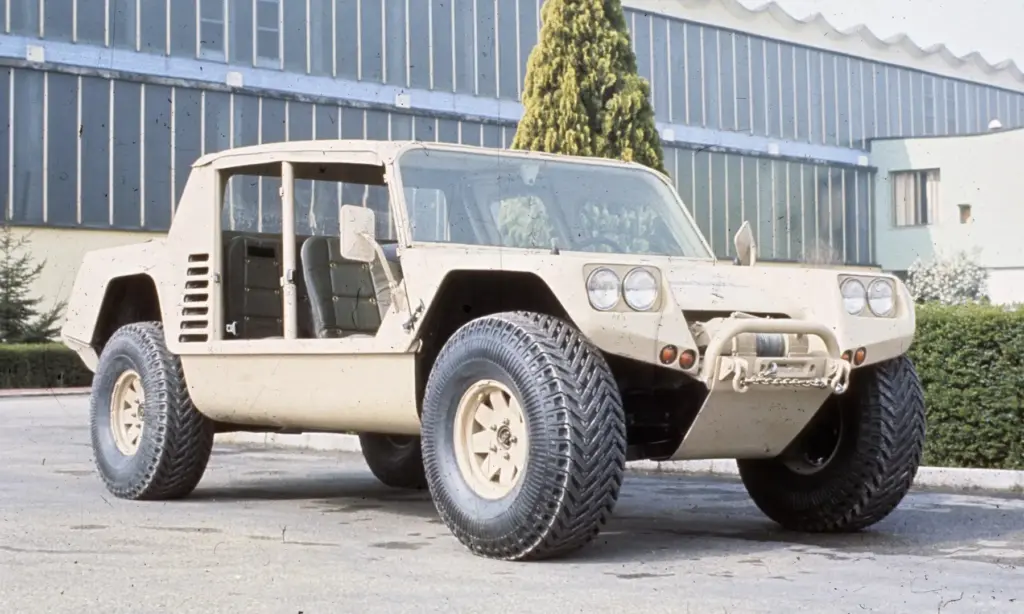
The story starts in 1977 with the Cheetah, shown at the Geneva Motor Show as an all-wheel-drive military prototype. It was not a luxury toy for rich farmers or a toned-down Countach on mud tyres. It used a rear-mounted Chrysler V8, a tubular steel frame, and an open glass-fibre body, which made the project look bold on paper but awkward in practice. Worse still, the intended US government contract never arrived.
Lamborghini tried again with the LM001, which kept the rear-engine layout but swapped in a Countach-derived V12. The problem was weight distribution. Desert testing exposed it quickly and brutally. The answer was simple: move the engine to the front, and the next prototype sequence, the LMA, finally pointed the project in the right direction.
LMA stood for Lamborghini Militaria Anteriore, an unglamorous label that hides a very important engineering correction. A five-speed ZF manual gearbox went in, front drive could be disconnected, and development also touched the LM003 with a turbodiesel and the LM004 with a 7,0-litre marine-derived V12.
LM002 and the birth of the Super SUV
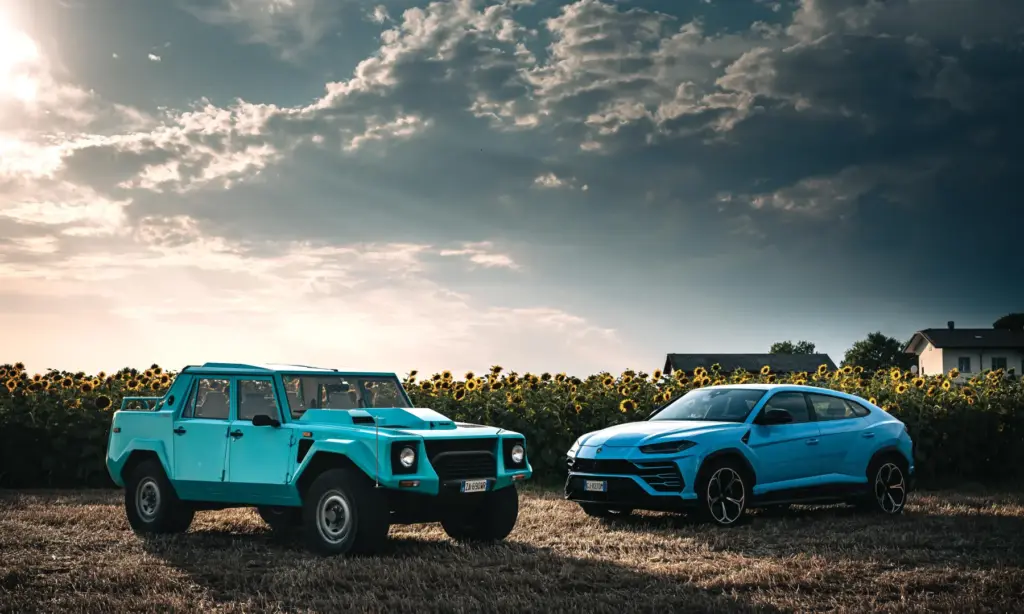
The finished answer arrived at the 1986 Brussels Motor Show as the LM002, the machine that deserves to be called the father of the Super SUV. It took the Countach Quattrovalvole 5,2-litre V12 and mounted it up front, where it made the most sense. Power output was about 330 kW, enough to push a 2,7-ton vehicle past 200 km/h, a number that sounded silly at the time.
Pirelli developed Scorpion tyres specifically for it, so the car could keep its pace in tough conditions without turning into a compromise. Inside, it was lavish in a way no military-derived machine had any business being. Leather, wood, air conditioning, and craftsmanship made the cabin feel like a private club with a transfer case.
Only 301 were built before production ended in 1992, including the LM/American version for the US market in 1989. Scarcity only sharpened the legend. The LM002 established a model line and set the template for every large, fast, overachieving Lamborghini that followed.
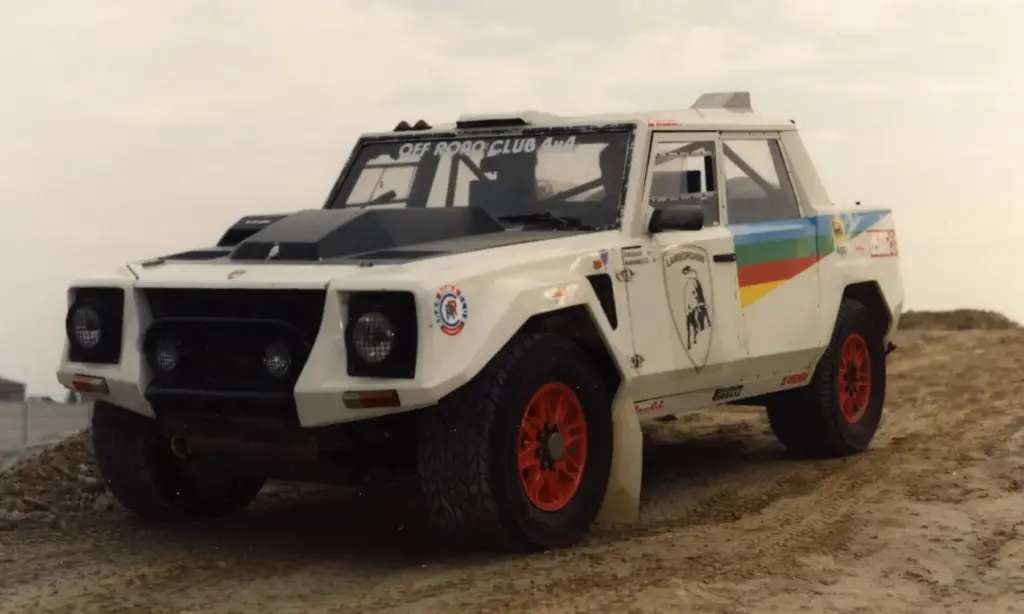
Incidentally, the LM002 was the basis for an ill-fated factory race team that planned to tackle the Dakar Rally. A car was developed for this grueling event, however, the appetite by Lamborghini’s, then, owners waned and the project was shelved. It was later picked up by a privateer Italian racer who continued the development program. The car eventually raced in one event, from which it retired.
Urus Arrives
Twenty-five years later, Lamborghini returned to the SUV idea with the Urus concept in 2012. The reception was positive and production model followed in 2017. This was not a revival in the nostalgic sense. It was a reset with the weight of new owners, Audi, behind it. To build the car, Lamborghini doubled the Sant’Agata Bolognese plant from 80 000 to 160 000 m² and added a new paint shop, because management knew this was going to be a volume seller.
The Urus also brought Lamborghini’s first twin-turbo V8, a 4,0-litre unit tuned for strong low-end torque. Output was 478 kW and 850 N.m, enough for 0 to 100 km/h in 3,6 seconds and a top speed of 305 km/h. Braking came from a carbon-ceramic system with 440 mm front discs, the largest fitted to a production car at launch. Rear-wheel steering and active anti-roll bars gave it agility that old-school SUV buyers found hard to believe until they drove it.
The design kept the family resemblance tight. The bodywork-to-glass ratio sits at two-thirds to one-third, and the hexagonal arches reference both the LM002 and the Countach. Inside, the “Feel like a pilot” philosophy make the cabin feel like a cockpit dressed for daily use. The result was immediate. The Urus brought a new audience to the brand and pulled Lamborghini into a bigger global footprint without dulling the badge. Sales figures, unsurprisingly, rocketed.
Performante, S and SE
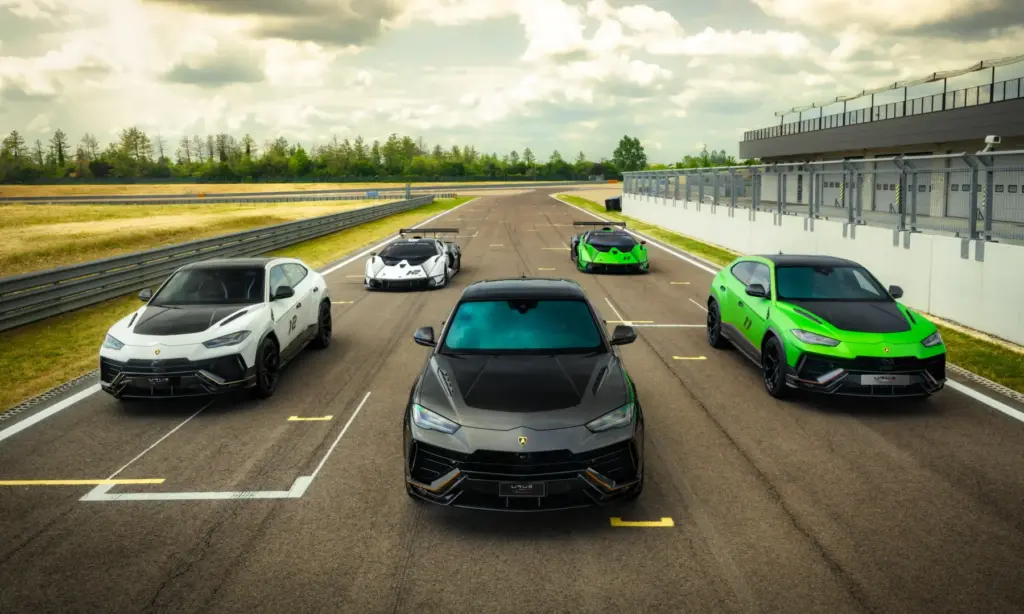
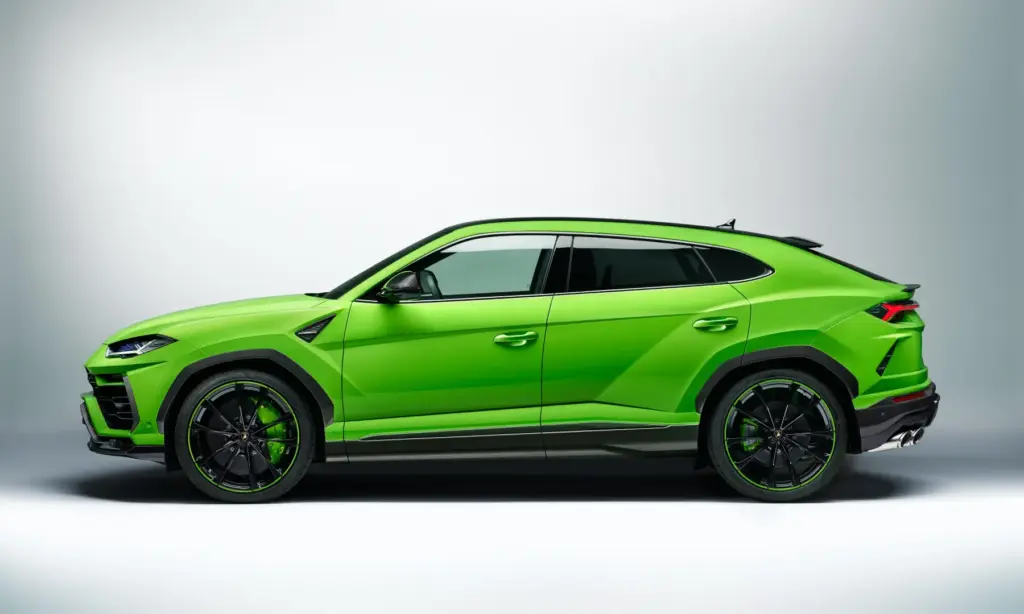
Once the basic formula worked, Lamborghini split it into various derivatives. The Urus Performante is for drivers who think comfort is a negotiation. It swaps adaptive air suspension for dedicated steel springs, which sharpens response and keeps the body flatter when the pace rises. The twin-turbo V8 is tuned to 490 kW and 850 N.m, and with weight reduction and carbon-fibre use it will cover 0 to 100 km/h in 3,3 seconds and reach 306 km/h. A carbon-fibre bonnet, an Aventador SVJ-style rear spoiler, Pirelli P Zero Trofeo R tyres, and an Akrapovic titanium exhaust make the intent obvious.
The Urus S takes the cleaner road. It also makes 490 kW and 850 Nm, but keeps adaptive air suspension, tuned to balance comfort, dynamics, and versatility. The sprint to 100 km/h takes 3,5 seconds and the top speed is 305 km/h. A revised front bumper, matte black stainless steel underbody plate, and bonnet with dedicated intakes sharpen the look, while Ad Personam broadens the palette with more than 60 exterior and interior shades plus Sophisticated and Sportivo stitching patterns.
Then comes the Urus SE, the latest and most advanced chapter. Revealed at Auto China Beijing in 2024, it is Lamborghini’s first plug-in hybrid Super SUV and the second model in Direzione Cor Tauri. The twin-turbo V8 works with a 141 kW electric motor for a combined 588 kW and 950 N.m. It reaches 100 km/h in 3,4 seconds, runs to 312 km/h, and can cover over 60 km on electric power from its 26 kWh battery. An electronic centre torque splitter and electronically controlled rear limited-slip differential give it a more precise dynamic character than the early Urus could ever have managed. The ‘floating’ bonnet borrows cues from the Revuelto, and the rear diffuser is shaped for more downforce and better cooling.
Special Editions
In addition to the ‘regular’ versions, Lamborghini has created several special editions of its best-selling model of all time. Among these are the Urus Performante Essenza SCV12, a limited edition reserved for owners of the track-only hypercar of the same name, featuring exclusive Ad Personam details inspired by motorsport. At Art Basel Miami Beach 2024 the company presented a model with special with Blu Glauco accents and 230 extra hours of hand-finishing, all inspired by the city of Miami.
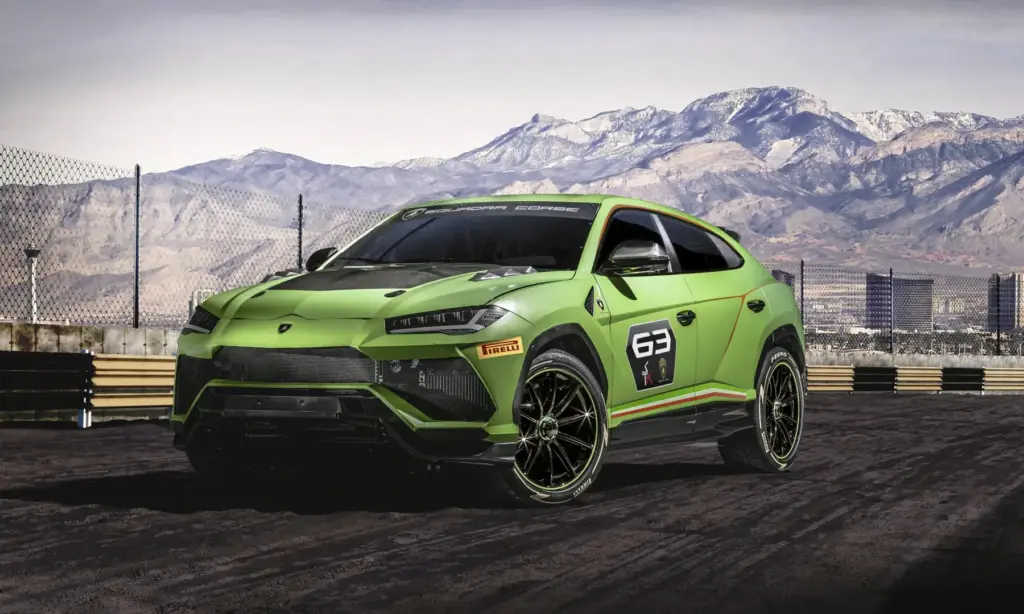
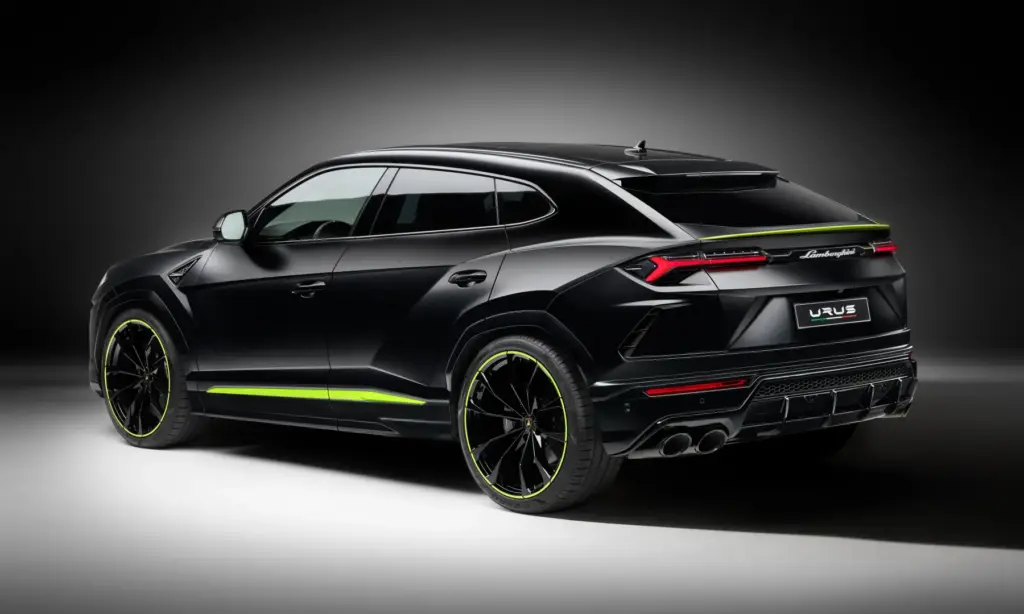
There was also the Urus ST-X Concept, a motorsport inspired version that was supposed to serve as the basis for a one-make off-road race series that didn’t materialise. Highlights included an FIA-spec roll cage, fuel cell, hexagonal side exhausts, a fixed rear wing, and 21-inch centre-lock wheels. A special version serving the Italian State Police, used for organ and plasma transport, adds a different kind of credibility. Most recently the company showed the Urus SE Tettonero Capsule limited to 630 units.
While sportscar purists may have choked at the thought of Lamborghini producing an SUV, the high-riding member of the family has become its top seller of all time. Over 35 000 have found new homes around the world, vindicating the decision to producer a ‘family’ Lambo.
![Porsche 911 GT3 vs Lamborghini Huracan STO Track Battle [video]](https://doubleapex.co.za/wp-content/uploads/2021/11/1-1-300x169.webp)
![Listen to New Lambo Engine Scream [video]](https://doubleapex.co.za/wp-content/uploads/2024/05/Lamborghini-Huracan-Successor-1-300x180.webp)
![Lamborghini Track Special Drag Race [video]](https://doubleapex.co.za/wp-content/uploads/2022/02/Lamborghini-Track-Special-Drag-Race-1-300x180.webp)
![Ode To The Lamborghini V12 [Gallery and Video]](https://doubleapex.co.za/wp-content/uploads/2023/01/634611-300x180.webp)
![Lamborghini Huracán STO Time Chaser_111100 [w/video]](https://doubleapex.co.za/wp-content/uploads/2023/02/Lamborghini-Huracan-STO-Time-Chaser_111100-2-300x180.webp)
![Lamborghini SC63 Endurance Racer Unveiled [w/video]](https://doubleapex.co.za/wp-content/uploads/2023/07/Lamborghini-SC63-300x180.webp)
![Lamborghini Huracan Sterrato Official Teaser [video]](https://doubleapex.co.za/wp-content/uploads/2022/07/Huracan-Sterrato-Official-Teaser-300x180.webp)

Have your say
Got thoughts on this?
No feedback yet on Tracing Lamborghini’s Super SUV Legacy From Cheetah To Urus SE. Kick the conversation off.
Free. Email link only — no password.