

A bakkie that costs R699 900 with leather, a sunroof, and a 360-degree camera should not exist in the same price bracket as a base-model workhorse with steel wheels and a rubber floor. The GWM P300 has parked itself at exactly that intersection, and the result is the most uncomfortable question Toyota has faced in decades: what exactly are you paying for when you buy a Hilux?
The arithmetic is brutal. A fully loaded P300 LT or LTD, complete with wireless Apple CarPlay on a 12.3-inch touchscreen, a fully digital instrument cluster, and soft-touch surfaces that belong in a German SUV, lands at roughly the same money as a stripped Hilux built for fleet duty. Step up to the Hilux Legend RS, with its 2.8 GD-6 producing 150 kW and 500 Nm, and you are past R750 000 before options, cresting R1 000 000 for the full flagship treatment. For that gap, you could buy a second used hatchback and still have change for a track day at Kyalami.
The Cabin Is Where the War Is Won
Toyota has spent forty years convincing South Africans that a bakkie interior should be washable, durable, and emotionally vacant. The Hilux Legend RS softens this philosophy with a motorised roller shutter, graphite sports bar, and JBL sound system, but the fundamental architecture remains resolutely analog. The screen is smaller. The dials are conventional. You are in a tool, not a lounge.
GWM read this room and built the opposite. The P300’s 12.3-inch display dominates the centre stack, flanked by a digital cluster that can be configured to show navigation, off-road angles, or tyre pressures. Wireless smartphone mirroring is standard, not a dealer-fit extra. LT and LTD variants add leather, a sunroof, and that surround-view camera system, which transforms tight trailering in Pretoria traffic from a shouting match into a solo operation. The materials are better than the Hilux’s; they are better than most SUVs costing significantly more.
This is not trivial specification creep. It represents a redefinition of what a lifestyle bakkie owes its owner. The P300 assumes you will spend hours inside it, that your commute is as much a part of the ownership experience as your load bed, that the vehicle is a daily driver first and a weekend hauler second. Toyota’s hierarchy inverts this. The Hilux remains a commercial vehicle that has been politely upgraded, while GWM has built an SUV with a load bed attached.
Power, Torque, and the 9-Speed Gambit
The P300 offers two turbo-diesel four-cylinders: a 2.0-litre with 120 kW and 400 Nm, and the 2.4-litre that generates 135 kW and 480 Nm. The smaller engine pairs with either a six-speed manual or the nine-speed automatic; the 2.4-litre comes exclusively with the auto. Four-wheel-drive is available across both displacements, and towing capacity peaks at 3.5 tonnes on higher-spec models.
Against this, the Hilux 2.8 GD-6 maintains a measurable advantage: 150 kW, 500 Nm, and a refinement edge that comes from years of iterative development. On paper, Toyota wins. On the ground, the margin narrows dramatically. Owner footage from mud runs in KwaZulu-Natal, dune passes in the Kalahari, and steep climbs in the Drakensberg shows P300s keeping pace through a combination of electronic diff-locks, low-range transfer cases, and generous ground clearance. The nine-speed automatic deserves particular credit, as its ratios are stacked tightly enough to keep the 2.4-litre on boost where an older six-speed would have lugged.
GWM has not built a better engine. It has built a sufficient engine, wrapped it in superior electronics, and priced the package so aggressively that the Hilux’s performance premium becomes a luxury tax.
The Ownership Equation Beyond the Sticker
Toyota’s defence rests on territory GWM cannot yet claim. The Hilux carries a 3-year/100 000 km warranty against GWM’s 7-year/200 000 km coverage. Toyota’s real armour is its network. A farmer in the Karoo or a contractor in the Eastern Cape can find a dealer, parts, and a technician who has rebuilt three 2.8 GD-6s before breakfast. GWM’s footprint is expanding fast, but in rural South Africa, “fast” is measured against decades of entrenched presence.
Resale value tells the same story. Hiluxes depreciate like granite. P300s, as a newer proposition with less track record, carry more uncertainty. The seven-year warranty mitigates some of this risk for the first owner, but the second-hand market has not yet rendered its verdict. Buyers who flip vehicles every three years face a real financial calculation. Those who keep them until the odometer stops will find the P300’s upfront savings compound through reduced financing costs and lower insurance premiums.
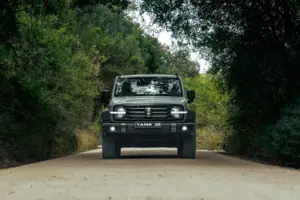
The GWM Tank 300 and the GWM P300 share major mechanical running gear under GWM’s modular ladder-frame architecture.
- Engine: The same 2.4-litre turbocharged diesel engine is shared directly between the updated Tank 300 diesel variants and the P300 commercial bakkie range.
- Transmission: Both utilize GWM’s proprietary in-house developed 9-speed automatic transmission.
- Chassis Architecture: They are built upon variations of the same heavy-duty, ladder-frame chassis platform designed for rugged off-road applications and high torsional rigidity.
- Cabin Switchgear & Controls: Select interior operational elements, such as the electronic gear selector knob layout and fundamental infotainment electronic architecture blocks, share common parts bin components.
This is a strong indicator that GWM are preparing to go the distance on backup and support for the P300 and the Tank in the age old strategy where shared components effectively reduces the logistics spares, services costs.

The Culture Test
No vehicle in South Africa carries the cultural weight in Afrikaans community quite like the Hilux. This icon functions as inherited wisdom, family tradition, and practical religion combined. The badge confers membership. The shape is instantly legible across a dusty fence line. Doubting a Hilux is, in certain company, treated as doubting the land itself.
GWM’s intrusion into this space has generated the kind of online argument that sustains bakkie forums through slow work afternoons. The P300 forces a question that previously required no asking: is the Hilux’s emotional premium quantifiable? If the GWM tows the same caravan, climbs the same farm track, and shelters its occupants in markedly greater comfort for R250 000 less, what precisely does the Toyota badge buy?
The honest answer, for many buyers, remains “peace of mind.” But the question itself is new. Five years ago, no mainstream challenger could provoke it. The P300 has made the Hilux defend its throne not by seizing it, but by proving the throne was always partly imaginary, constructed from accumulated habit rather than current capability.
Toyota will respond. The next Hilux will likely adopt larger screens, more digital integration, and sharper pricing. That is how market pressure works. For now, though, a bakkie buyer walking into a showroom with R700 000 faces a genuine fork in the road. One path leads to the most proven vehicle on African roads. The other leads to more equipment, more comfort, and more uncertainty, for the same money or less.
The P300 has not killed the Hilux. It has done something more disruptive. It has made the choice difficult.
PS.
I have to apologise to the managing editor for making this post.
Yes, yes I know this isn’t a “bakkie site”, but damn this P300 isn’t a just bakkie it’s another beautiful masjien built by GWM.
![Watch BMW XM Crash At Pikes Peak [video]](https://doubleapex.co.za/wp-content/uploads/2023/11/BMW-Crash-at-Pikes-Peak-300x180.webp)
![Aspark SP600 is World’s Fastest Electric Car [w/video]](https://doubleapex.co.za/wp-content/uploads/2024/06/Aspark_SP600_07-1-300x180.webp)


![GT3 Racer Loek Hartog Makes Heroic Save of Rival from Fireball [video]](https://doubleapex.co.za/wp-content/uploads/2026/09/loek-hartog-ollie-millroy-china-gt-300x169.webp)

![Hennessey Blackbird Rejects the Digital Hypercar Future [w/video]](https://doubleapex.co.za/wp-content/uploads/2026/08/Hennessey-Blackbird-01-300x200.webp)

Have your say
Got thoughts on this?
No feedback yet on GWM P300 Forces Toyota Hilux To Defend Its South African…. Kick the conversation off.
Free. Email link only — no password.