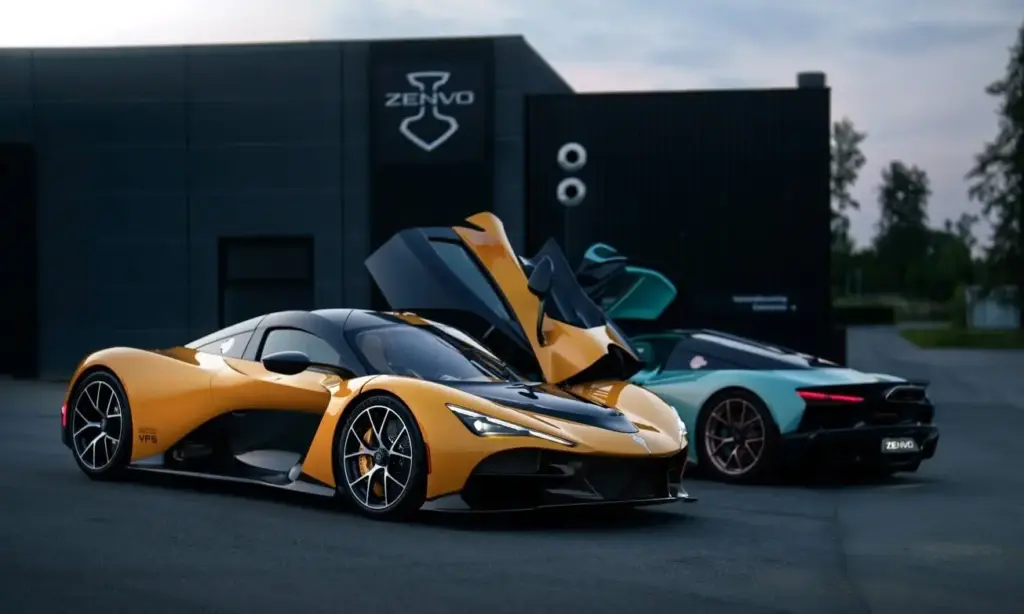
Jens Sverdrup is the executive chairman at Zenvo Automotive. He is a brand and product architect with 25+ years at the extreme end of the automotive and hypercar industry. He recently developed a framework for what separates success from failure in the super and hypercar industry.
The hypercar and supercar space is littered with exceptional products that never became enduring brands. What separates the survivors is not so much talent or ambition — those are merely table stakes. I believe It is the alignment of these ten distinct commandments, each of which can collapse the entire brand if it fails.
01. A Founder Figure With Gravitas, Eccentricity & Vision
Not just a vision, but a person the world wants to believe in — someone with the power to win people over and convert non-believers into believers. You need the ability to win a room by conveying passion, credibility, and conviction. Koenigsegg, Pagani, and Bugatti under Ettore and later Piech — the brand is the founder’s obsession made physical and must reflect his personality. The founder must be the story, the spokesperson, the narrative and the living proof of the philosophy.
Credibility is non-negotiable. The hypercar buyer is too sophisticated and smart for pretense and forced narratives, and the automotive media love to expose it after witnessing countless failed vaporware brands. Authenticity at the top is the only foundation on which to build. The most successful brands almost have a cult following, and the founder figure almost acts like a cult leader. You either have gravitas, or you don’t. It can be refined but not faked.
In the long term, the founder must scale without becoming a bottleneck. The myth must survive beyond the individual. Ferrari, Lamborghini and Porsche are great examples here — but it took them 40–50 years to get there.
Authenticity at the top, or nothing.
The founder figure is the brand and the brand is the founder figure. This alone equates to at least 50% of what it takes for a hypercar company to become successful. Sometimes more.
02. A Product With A Clear “Claim To Fame”/USP
One thing the vehicle does better than anything else — and that claim must be defensible and repeatable. Top speed, lateral G, acceleration, lap records, powertrain innovation, weight, sound, engagement, design, etc. It does not need to win every category, but it must dominate one completely. The world prefers clear Flavors.
The USP is the gravity well that everything else orbits around. Without this, the brand has no clear reason to exist in a buyer’s mind or a journalist’s story. If it cannot be expressed in one clear sentence or message a journalist immediately repeats, it fails. I am looking for a sneezeable line (Not a real word, I know).
Must be dominant and instantly repeatable.
03. A Long Game Mentality – Underdog Story, Ultra Strong Ethics, Humble Beginnings
Every enduring brand in this space has survived near-death moments and PR disasters. What separates the survivors is the refusal to compromise the product or the positioning for short-term revenue. Patience with the market, discipline with volume, and the courage to say no to the wrong partners, investors, customers or the wrong deals.
The long game also means building institutional knowledge — engineering, supplier relationships, customer trust — that compound over time. Speed-to-market thinking is a category error in the hypercar space. Nothing beats organic growth, and this takes its sweet time. Respect, trust and credibility are earned by proof. They are near impossible to buy (unless you have VW AG funding, maybe…)
Short-term revenue compromises permanently damage brand positioning.
04. Earned Media Over Paid Media
Hypercar brands are predominantly built through genuine PR and word of mouth through the network. The hypercar buyer is allergic to advertising, especially paid advertising. Paying your way equals weakness, and a weak brand won’t sell, no matter how great the product is. In short, it is brand suicide. The brands that endure build their reputation through network, word of mouth between the right people, media, events and gaining credibility by proving themselves.
Important nuance: Earned media is the output of getting all the other commandments right — not a strategy in itself. Brands that chase PR as a strategy tend to look like they are chasing PR. Chasing equals weakness. Weakness equals no sale. The story must be real before it can be told. Paid media cannot create legitimacy; it can only amplify existing credibility.
05. A Small, Obsessed Team
The best hypercar companies run more like racing teams or skunkworks than car companies. Flat structures, extreme ownership, people who could work anywhere but chose this because they believe in it. The moment it starts feeling like a corporation, the magic starts leaking out. It becomes a fireball of energy that people feel. Being non-corporate is a selling point and a differentiator for the client seeking a genuine, almost tribal experience.
Mavericks and trailblazers — yes please, but aligned ones pulling in the same direction with close to religious conviction. The difference between a team of brilliant individuals and a brilliant team is shared obsession and passion.
Stay small in mindset even when scaling headcount.
06. Financial Architecture That Matches the Timeline
THE SILENT KILLER — AND OFTEN THE MOST OVERLOOKED COMMANDMENT
Some failed hypercar start-ups had the vision, the product, even the team — and died because the capital structure was wrong. Investors with a three-year horizon exit funding ten-year-plus businesses. The brands that survived either had a patient single backer, a founder with personal resources, or found a way to make customer deposits fund development — based on market trust and a founder persona with credibility and accountability.
Misaligned capital does not just create financial pressure — it creates governance pressure, which corrupts decisions at every level. In extreme cases it dilutes the vision and product by making it compromised to please an investor who is not plugged in enough to make sound decisions. A compromised product is a hard sale. A compromised vision is the beginning of a compromised brand. Mix them both, and you have a failed project.
Primary failure mode of the industry. Misaligned investors destroy product and vision.
07. The Right Early Adopter Clients & Dealers
SOCIAL PROOF THAT COMPOUNDS — OR DESTROYS
The hypercar world is small, and gossip travels fast. Your first ten buyers define your brand’s social proof for years. One wrong placement — a bad actor, a flipper, someone who crashes or misbehaves publicly — can do lasting damage that takes a decade to repair. It can take decades to build a solid brand, but it can be torn down in a day.
Bugatti and Pagani were famously selective in their early years, and that selectivity became part of the brand equity. The waiting list is not just a commercial tool — it is a curation mechanism. Who owns your car is part of what your car means. These early adopter clients and dealers are all ambassadors and innovators who will help shape the brand.
One of my guiding principles comes from the Soup Nazi character in Seinfeld. He screened his customers and was not afraid to turn away bad ones, even when the queue stretched around the block. NO SOUP FOR YOU. NEXT!!
The first clients and ambassadors define long-term brand perception.
08. Over-Deliver on Promise, Reliability and After-Sales
“THE PROOF IS IN THE PUDDING”
The product must work. Not in controlled conditions, not on a closed track with factory support on standby — in customer hands, repeatedly, in the real world. Prototype success is irrelevant. Press car performance is irrelevant. The only metric that matters long-term is whether the car your customer received delivers on everything you told them it would, day after day, without drama.
In the hypercar space, customers talk. They talk at concours events, at track days, in WhatsApp groups that no PR agency has access to. One delivery failure, one unreliable example, one customer left stranded, can ripple through the network with extraordinary speed. Conversely, a car that repeatedly exceeds expectations — that starts every time, that sounds better at 5 000 miles than at delivery, that the factory calls before the customer calls them — becomes a legend.
After-sales is a brand strategy, not a necessary evil.
How you treat a customer after the sale defines whether they buy again, refer others, and speak well of you in the rooms that matter. The hypercar buyer does not expect perfection — they are sophisticated enough to know that hand-built, low-volume machines require attention. What they will not forgive is indifference, slow response, or being made to feel like a transaction once the money has changed hands.
The gold standard is proactive after-sales: knowing the car’s condition before the owner does, scheduling service around their calendar, treating every interaction as a relationship touchpoint. This is not customer service — it is relationship management at the highest level. The brands that have mastered after-sales — Pagani, Koenigsegg — have owners who would never consider switching. That loyalty is worth more than any marketing budget.
If the product doesn’t work repeatedly in customer hands, the brand collapses regardless of narrative.
09. Trust, Governance & Ownership Transparency
“IT TAKES A VILLAGE TO RAISE A CHILD”
The hypercar community is a village, and villages run on trust. Ownership transparency and clean governance are not administrative niceties — they are fundamental prerequisites for operating credibly in a high-trust, high-scrutiny industry. The buyer spending €500 000 or more on a vehicle is not just buying engineering. They are placing their trust — and in many cases their name — alongside yours.
Any ambiguity in who owns the business, who controls decisions, or who stands behind the brand creates a signal of instability that travels fast through the network. Sophisticated buyers, the automotive press, dealer partners and institutional investors all conduct due diligence. What they find — or fail to find — in a company’s ownership structure either reinforces or undermines everything the brand claims to stand for.
Governance is product
In a small, founder-led business the governance structure is not separate from the brand — it is an expression of the brand’s values. Transparent shareholding, clean board oversight, and clear lines of accountability signal exactly the same things as clean engineering and honest design: nothing hidden, nothing arbitrary, every element in honest relationship with every other.
The failure mode here is well documented. Governance problems create governance pressure, which corrupts commercial decisions, which distorts the product, which destroys the brand. The path from a sanctioned or conflicted investor to a compromised car is shorter and more direct than most founders want to believe. It has ended promising brands before. It will end more.
Accountability as competitive advantage
The brands that have made it through governance crises — and some of the most celebrated names in this industry have faced them — did so by moving fast toward transparency, not away from it. Public accountability, clean communication with stakeholders, and the willingness to make difficult ownership changes before they become forced ones: these are not signs of weakness. In this industry, they are signs of seriousness.
Ownership transparency is a selling point. In an era of increasing scrutiny, the brand that can say ‘we have nothing to hide’ and prove it has a genuine competitive advantage over those that cannot.
Clean ownership and honest governance are mandatory. They are not separable from the product.
10. Resale Value – The Appreciating Asset
“PRODUCT VALUE BUILDS BRAND VALUE”
When a client signs the order form, they are not just buying a car. They are making a capital decision. At the very moment of purchase, a sophisticated hypercar buyer is already modelling the exit: how liquid is this asset, how does it hold value, what will ownership cost in total, and how does this compare to the alternatives competing for that same allocation of capital?
Resale value is therefore not a secondary consideration — it is a primary one, and founders who treat it as someone else’s problem misunderstand the nature of their own market. An appreciating asset lowers the psychological cost of the purchase, shortens the decision cycle, reduces objections at the point of sale, and creates a compounding flywheel: strong resale attracts more serious buyers, which improves curation, which protects resale, which attracts more serious buyers.
How resale value is built
Resale value is not marketed into existence — it is engineered into existence through every other commandment in this framework. Volume discipline is the foundation: a brand that produces only as many cars as the market truly wants will always command stronger residuals than one that chases revenue through over-production. Production numbers are public. The market knows.
Provenance matters enormously. A numbered, documented, single-owner example with factory service history and a compelling story commands a premium over an undocumented car of identical specification. This means that everything the brand does — the care of its records, the rigour of its delivery process, the quality of its ownership documentation — directly contributes to future value.
The secondary market as brand barometer
Watch the secondary market carefully — it is the most honest feedback mechanism available. Auction results do not lie. If early examples are trading at premiums, the brand has pricing power, cultural cachet, and collector legitimacy. If they are trading at discounts, the market is telling you something that your own sales data may be concealing.
The truly enduring brands — Ferrari, Pagani, Koenigsegg — have created secondary market cultures that actively reinforce the primary market. Collector communities, factory certification programmes, dedicated auction appearances: these are not accidents. They are deliberate extensions of brand strategy into the ownership lifecycle.
The client who makes money on their first car will almost certainly be back for their second. The client who loses money is gone, and they will tell people why.
An appreciating asset is the ultimate endorsement. Protect volume discipline and the secondary market, and your brand will be protected.
The Red Thread – Authenticity Under Pressure
The market has an extraordinary ability to detect when any one of these commandments is being performed rather than truly lived. The brands that endure are not the ones that got everything right from the start — they are the ones that never stopped believing in the thing that made them start.
Certain Failure:
Most brands fail due to a missing USP, wrong capital, weak narrative, the wrong early customers, and over-marketing/over-promising. The failure is rarely dramatic — it is usually a slow drift away from the founding principles, commandment by commandment, until the brand no longer knows what it stands for and why it exists.
“Pressure reveals the truth of the brand.”
“Humble beginnings. David vs Goliath, Strong vision, Strong product, Brand, and product control, Cult-like following, Healthy governance and 100% accountability. Sounds easy, doesn’t it?”






![2026 Dakar Stage 5 Results – Flying Fords [w/video]](https://doubleapex.co.za/wp-content/uploads/2026/01/Mitch-Guthrie-won-2026-Dakar-Stage-5-300x180.webp)




Have your say
Got thoughts on this?
No feedback yet on How to break a hypercar brand for dummies – Jens…. Kick the conversation off.
Free. Email link only — no password.