

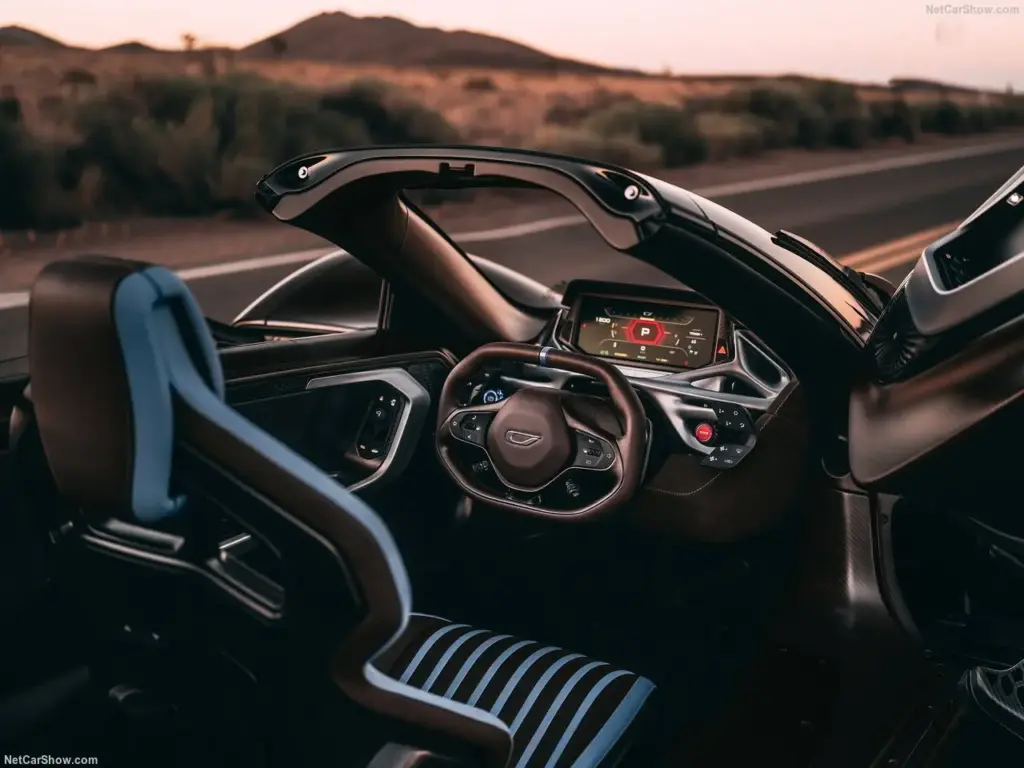


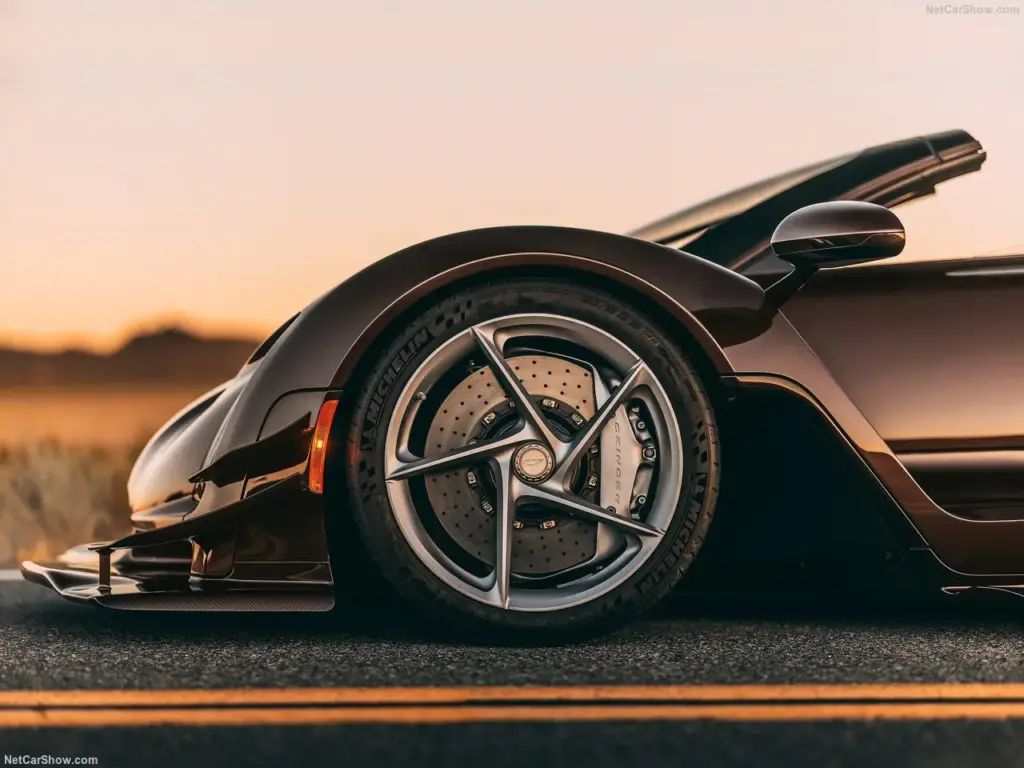
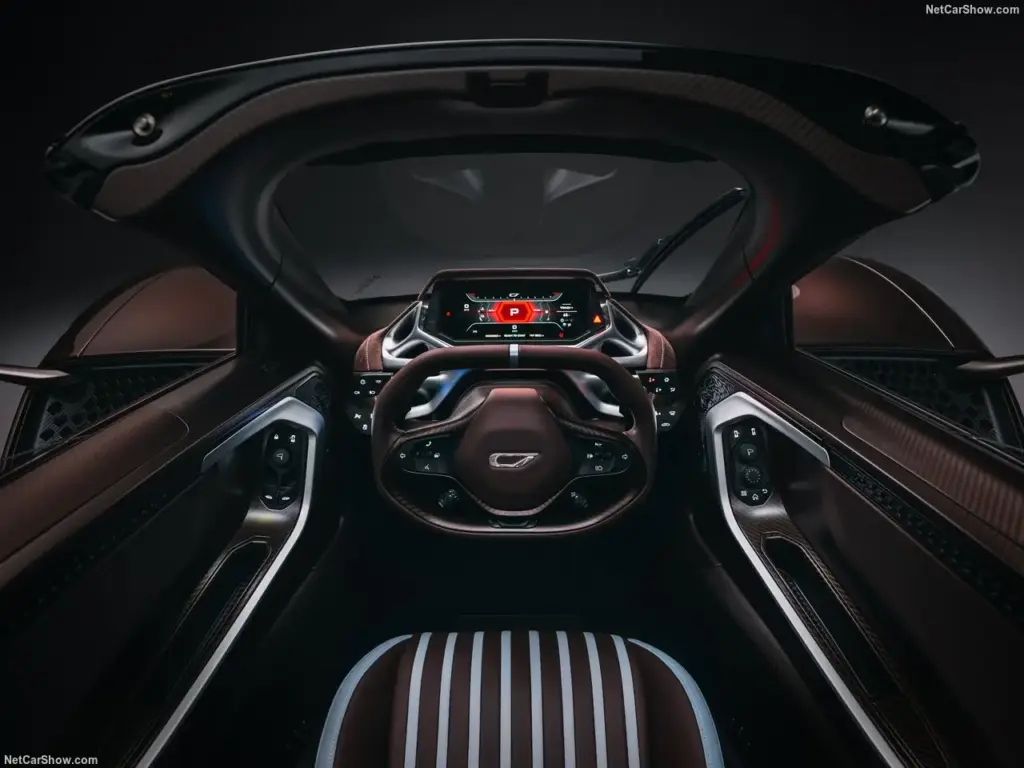
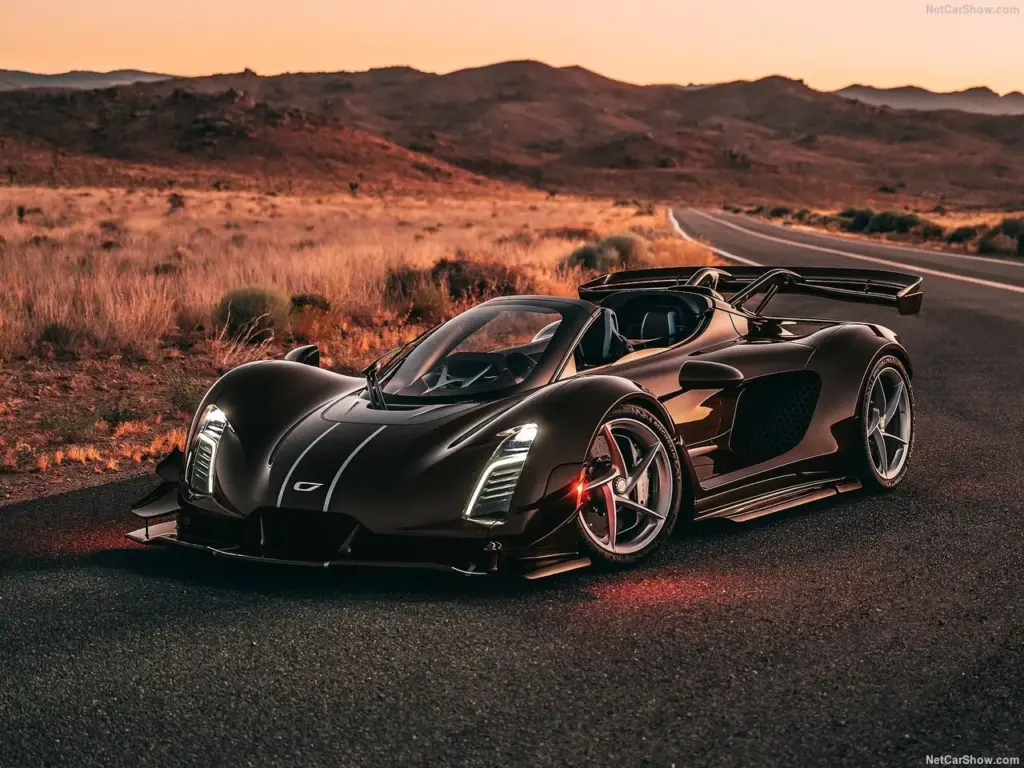


The 21C Spyder is the latest from the California-based hypercar start-up. With the roof off, a central seat fixed in the middle, a V8 screaming inches behind your head, and massive hybrid punch, Czinger did not add a targa panel and call it a day. It took the 21C formula, stripped the lid off, and turned the whole thing into a louder, faster, more exposed machine.
The numbers make even hardened petrolheads glance twice. It has 932 kW, goes from 0 to 100 km/h in 1,92 seconds, covers the quarter mile in 8,7 seconds, and generates 1 485 kg of downforce at 240 km/h with the roof removed. That last figure is the real tell. This is not a cosmetic Spider; it is an open-top hypercar that still wants to pin itself to the road like a racecar on slicks.
A screaming V8
Czinger did not start with an engine and then look for a body around it. The cabin layout came first, and the engine had to fit. The result is a bespoke 2,88-litre twin-turbo V8, built to live in a very tight space behind the central seat and to breathe hard enough to spin to 11 000 r/min. That engine is a serious piece of work. It weighs 105 kg, considerably less than the average hypercar motor. It is also homologated for road use
The combustion engine is only half the story. Czinger pairs the V8 with three permanent magnet synchronous electric motors. Two sit on the front axle, each driving one wheel. The third is a Motor Generator Unit attached to the crankshaft through a geartrain.
That MGU does more than keep the batteries happy. It helps spin the crank to trim turbo lag, then recovers surplus energy and sends it into the pack or out to the front axle when needed. The battery setup is simple on paper and serious in practice, with two 2,1 kWh units for a combined 4,2 kWh at 800 V. The electric side contributes 374 kW, pushing total output to 932 kW and 938 N.m.
Open top magic
Most convertibles lose structure, aero, or both when the roof comes off. The 21C Spyder does neither in any meaningful way. At 240 km/h, the 21C Spyder generates an immense 1 482 kg of downforce with its roof removed, the most of any open-top road car. With the roof in place, that figure rises to 1 500 kg.
The bodywork is doing a lot of the heavy lifting. The central seating position reduces frontal area and helps the car reach a lift-to-drag ratio of 3.0 to 1. Because the cockpit is so narrow, Czinger can run full-length channeled side splitters on both sides. A conventional side-by-side cabin would not leave that much space to play with.


Up front there is an extended splitter that uses ground effect to create low pressure ahead of the front axle. Twin dive planes push air away from the front wheels so the tire wake does not spoil the cleaner flow feeding the floor and rear diffuser. Along the sides, shaped surfaces keep the low-pressure system alive from nose to tail, then a slotted inlet just ahead of the rear tires re-energizes the flow.
Underneath, the diffuser runs almost the full length of the car and wraps around the additively manufactured rear subframe, the powertrain ancillaries, and the gearbox casing. At the back sits a dual-element wing with floating upper and lower panels, swan-neck uprights, and slotted endplates. It is mounted at the car’s highest point and can be adjusted in three ways for different circuits. This is track car thinking wearing road plates.
Driver feedback
Czinger’s engineering team leans on Formula 1, Le Mans prototypes, top OEM experience, and aerospace thinking. Steering weight, brake progression, and cornering behavior were all developed from the ground up to make the driver feel linked to the road instead of insulated from it.
Hydraulic steering gives direct feedback, including the way the front motors are delivering torque and how much load is sitting in the wheel. The brake system is tuned to feel pressure-based, closer to a race car than a typical road hypercar.
The open-top format sharpens the whole thing. With the roof removed, the sound from the in-house V8’s airbox and roof-mounted intake is no longer filtered into the background. It hangs over the central seat, along with the wind, the turbo whistle, and the kind of mechanical noise most road cars work hard to hide.
Tech Spec
- Engine: 2,88 litre twin-turbocharged flat-plane V8
- Electric motors: 3 permanent magnet synchronous units, 2 front axle motors plus 1 crankshaft-mounted MGU
- Combined output: 932 kW
- Combined torque: 938 N,m
- 0 to 100 km/h: 1,92 sec
- Quarter mile: 8,7 sec
- Top speed with roof closed: 330 km/h
- Open top downforce at 240 km/h: 1 482 kg
- Closed roof downforce: 1 500 kg












Have your say
Got thoughts on this?
No feedback yet on Czinger’s 21C Spyder Unleashes an 11 000 r/min Open-top Assault. Kick the conversation off.
Free. Email link only — no password.