

Audi has just pulled the wraps of an all-new nameplate, say hello to the Q9. This is the biggest and, claimed to be the most luxurious Audi ever made. With the Audi Q9 the brand has stepped up to fight against the likes of the Mercedes-Benz GLS and BMW X7 in the all-important US market. This model feels more assertive for a brand that has spent years refining the long, understated German-SUV look. Good news for local fans of the Four Rings is that Audi South Africa is planning on introducing the flagship SUV into the local market before the middle of 2027.
In the future, ‘Vorsprung durch Technik’ will increasingly be defined by the in-car experience – because cars are much more than just a means of transportation. For many of our customers, they are becoming mobile living spaces. That is exactly what the Audi Q9 represents as the new flagship of our portfolio. Premium materials, individual electric seats in the second row, and automatic doors underscore our commitment to quality in the interior. When combined with the latest driver assist systems and a holistic user experience, it becomes clear where we are taking the Audi brand
– Gernot Döllner, Audi CEO
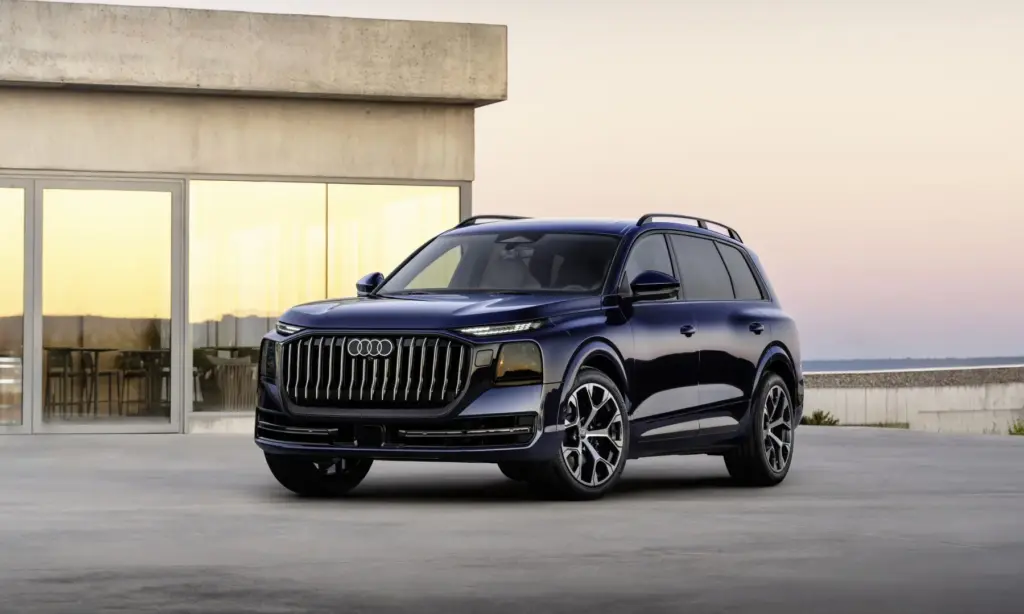
The front end
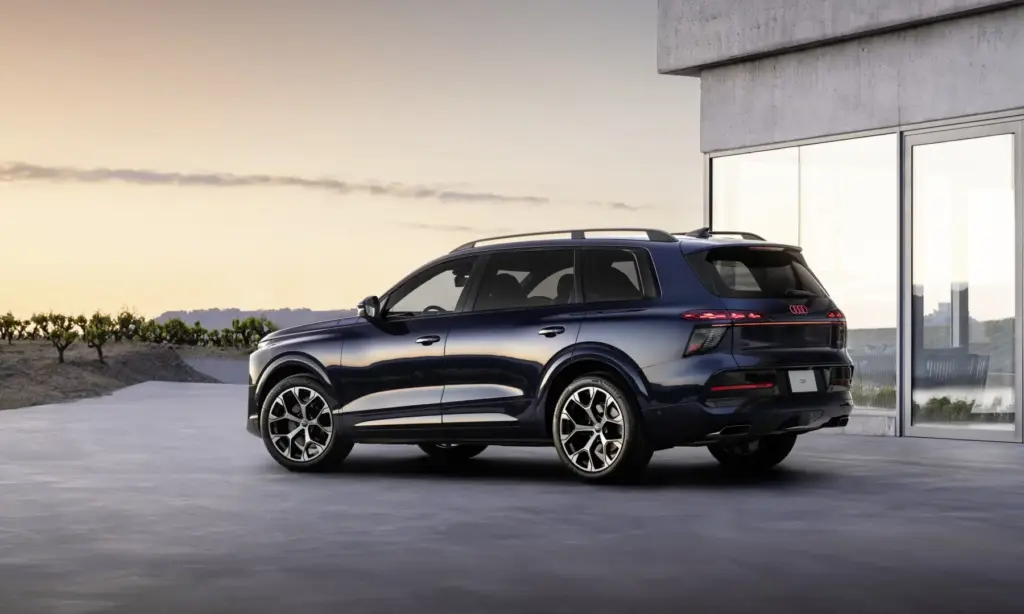
The Q9’s nose emphasises mass and a bluff nose. Audi fused the Singleframe grille and headlights into one continuous black mask, then stretched the grille down into the lower fascia for a taller, more upright stance. The effect is simple and signals its top-of-the-range status. The rest of the body follows this logic. The beltline runs straight, the shoulder line is pronounced, and the long wheelbase stretches the doors and rear quarter. Larger rear doors and a long back end suggest a rolling lounge with significant road presence, not just a high-riding wagon. An illuminated Singleframe is also available, using LED tech to make the front end more theatrical after dark.
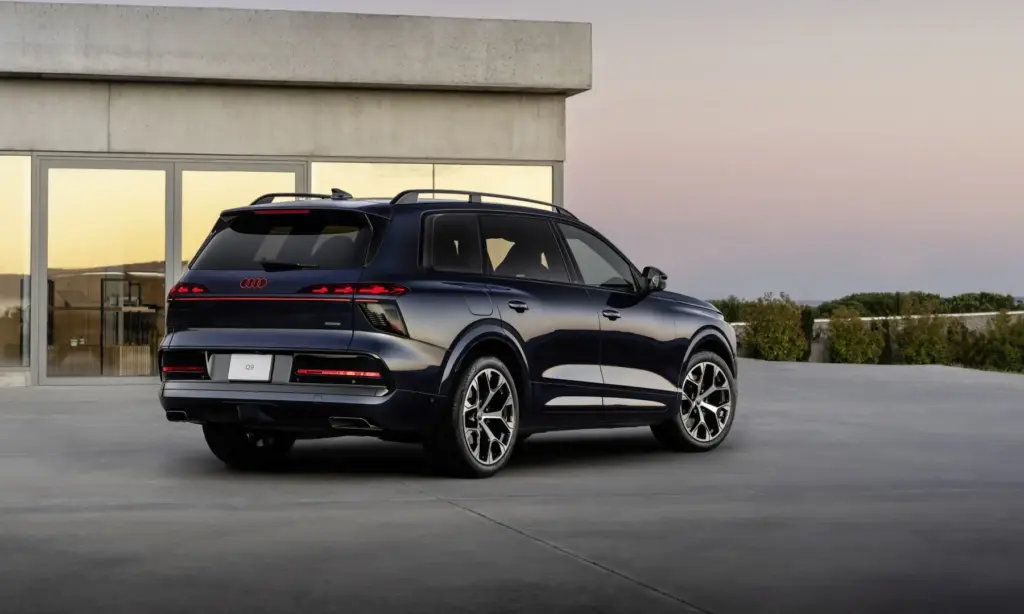
At the rear, Audi avoided clutter. The number plate sits in the bumper, leaving the tailgate clean. Curved digital OLED tail lamps, a production first, are the highlight, linked by a full-width LED strip with illuminated Audi rings. This sharp design also improves night visibility. A side welcome light projects the Audi Sport rhombus motif onto the ground beside the doors, a detail buyers at this level notice immediately.
More lounge than cabin
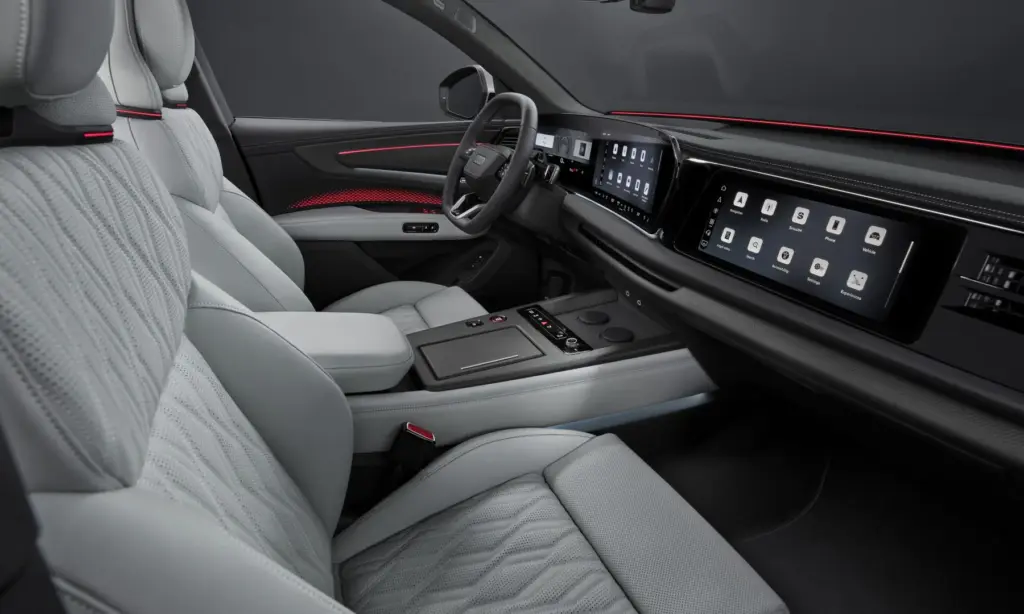
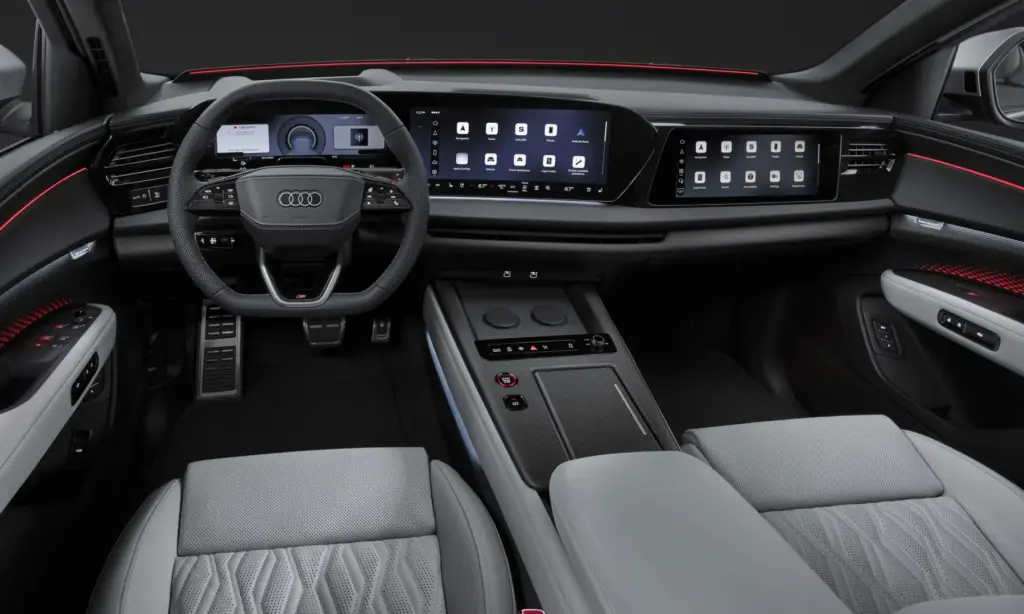
Inside, the Q9 prioritises space and geometry. The dashboard and door panels feature a tidy, integrated layout with crisp surfaces and restrained vents. The air outlets are subtle, yet electrically adjustable through the interface, fitting the car’s quiet, high-end feel.
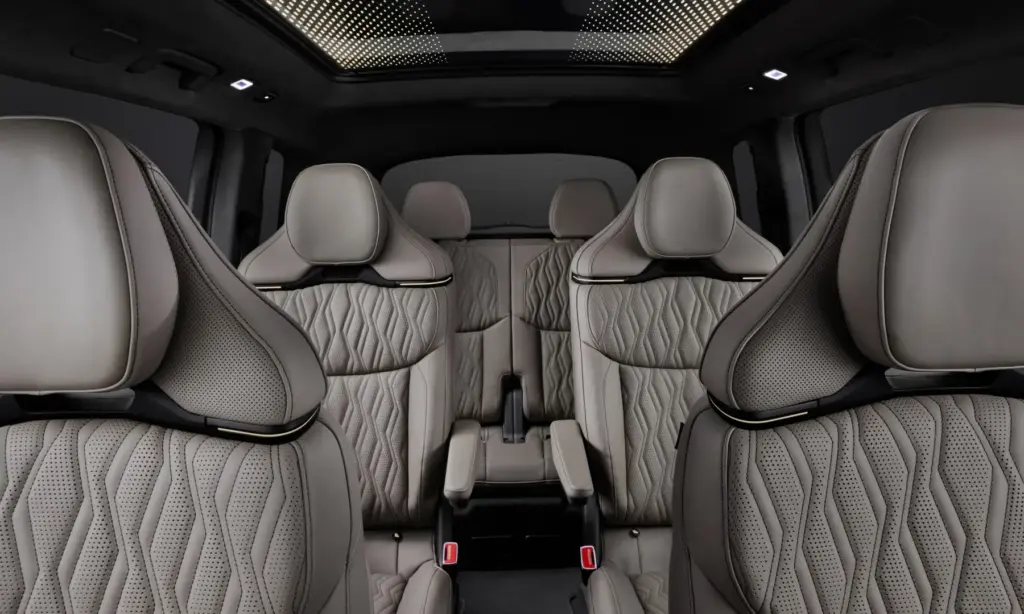
Seven seats are standard, all electrically adjustable. Buyers prioritising comfort over maximum capacity can choose a six-seat layout with individual middle-row chairs. Audi also introduces automatic doors for the first time, with a wide opening angle and obstacle detection. This feature highlights the Q9’s position in the range; it’s not a gimmick, but a way to make ingress and egress feel luxurious.
Seats can be specified in several ways. Front sports seats offer ventilation, while sports seats plus add heating, ventilation, massage, and seat-mounted controls. Audi even extended heating beyond the chairs, with optional surface heating for the door armrests and the center armrests in both rows. That’s pretty indulgent, but the way that brands have to operate to differentiate themselves in this era.
The seven-seat version uses a second row with a 35/30/35 split. All three seats have Isofix points, and the outer second-row seat can slide and tilt electrically without folding flat, meaning child seats don’t need removal to access the third row. The third row benefits from the Q9’s 3 140 mm wheelbase, allowing adults to fit comfortably. The seatbacks fold 65/35, and the 65 percent section can also be manually divided into 35/30/35 by dropping the centre portion. The trunk can control the folding functions, and the comfort entry function can be activated through the MMI or a button in the rear door area.
Light and space
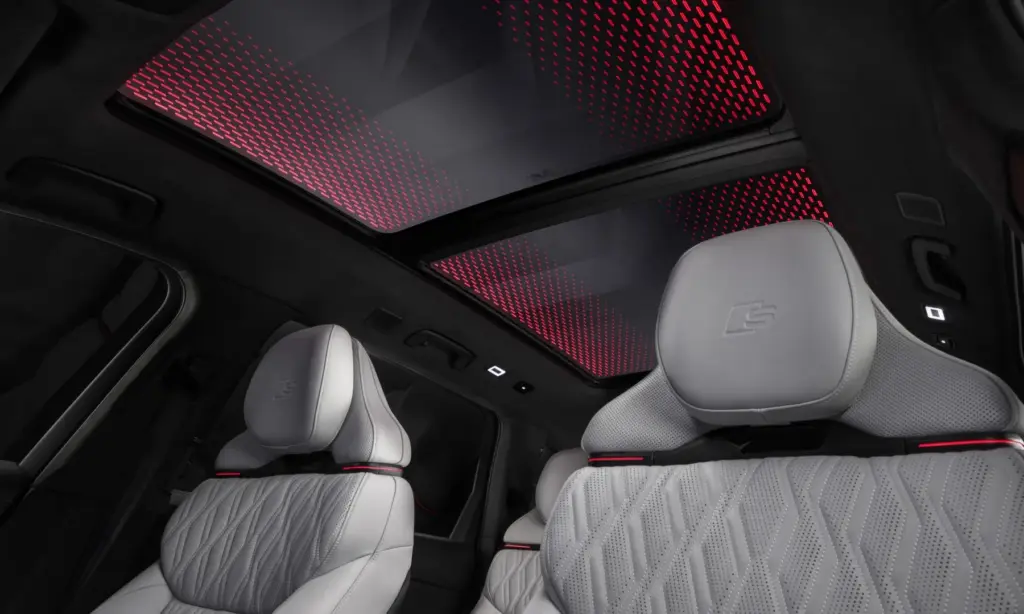
The standard panoramic roof is one of the Q9’s biggest cabin features; Audi says it’s the largest panoramic sunroof ever fitted to a production model. It opens or tilts, uses a stepless mechanism for variable ventilation, and can be specified with switchable transparency through nine individually controlled sections. When parked, it turns opaque automatically, then restores the last setting on restart.
The glass blocks over 99,5 percent of UV radiation, eliminating the need for a traditional blind. Audi also added a deflector to tame wind noise, and the roof can be operated from the overhead module or the MMI. In the top trim, it gains 30 colors that sync with the ambient lighting when closed, while 84 LEDs in the roof help give the cabin its own evening atmosphere.
Screens, sound and an assistant
The main display setup is a curved OLED panel combining a 12,3-inch Audi virtual cockpit with a 14,5-inch MMI touchscreen. A 12,3-inch screen with privacy mode sits ahead of the passenger, preventing the driver from seeing video or other distracting content while the car is moving. When unoccupied, it defaults to a background image.
The software runs Android Automotive OS and includes the Audi Application Store, with categories such as music, video, gaming, navigation, parking and charging, productivity, weather, and news. The voice assistant has been upgraded into a self-learning system that handles a wide range of vehicle functions in natural language. If the car cannot answer a general question, ChatGPT steps in, but only after the system has dealt with vehicle commands, destinations, and weather. A factory-integrated dashcam is also on the options list for incident recording.
Audi paired all of this with Bang & Olufsen premium audio with 4D sound. The setup uses 22 speakers and 1 360 Watts, plus headrest speakers and front seat actuators. Those headrest units handle private calls, navigation prompts, and surround sound without blasting the whole cabin. Interaction light ties into the system, syncing illumination with music and album art. It seems a bit showy, so we wonder how many will opt for this.
Diesel power
It is interesting that Audi seems to be returning to diesel power. The recently launched (in SA) Q3 has a small turbodiesel. And so the Q9 continues the trend. Under the skin, the Q9 launches with a V6 diesel in 220 kW form for selected markets. The same engine is also offered as a 180 kW version. The stronger tune produces 630 N.m while 180 kW version makes 500 N.m.
Both versions use MHEV plus, which combines a Q9-specific powertrain generator, a belt alternator starter, and a lithium iron phosphate battery. The generator can add up to 18 kW for launch and overtaking, support electric driving, and ease the load on the combustion engine. Eight-speed tiptronic and permanent quattro all-wheel drive are standard.
Audi also fitted an electric powered compressor with 7,5 kW peak output and 3,5 kW continuous power. Working with two-stage turbocharging, it can build boost pressure to 3,6 bar in 1,2 seconds. This hardware gives a big diesel proper urgency from low speed. It is the right answer for a large flagship SUV that still has to feel effortless when loaded with people, luggage, and a full tank of fuel.
The international press material also made mention of an SQ9 version. However, it seems that high-performance derivative will be introduced to select markets. The SQ9 is powered by a twin-turbocharged 4,0-litre V8 that produces 441 kW. Incidentally, the more powerful SQ9 has a different facia treatment to its siblings.
![The World’s First Audi RS2JZ [w/video]](https://doubleapex.co.za/wp-content/uploads/Audi-RS2JZ-300x180.webp)
![Audi Q4 E-Tron and Q4 E-tron Sportback Debut [w/videos]](https://doubleapex.co.za/wp-content/uploads/2021/04/Audi-Q4-E-Tron-front-and-rear-300x180.webp)
![Audi EV vs ICE Drag Race [video]](https://doubleapex.co.za/wp-content/uploads/2022/09/Audi-EV-vs-ICE-Drag-Race-1-300x180.webp)

Have your say
Got thoughts on this?
No feedback yet on Audi Q9 Makes a Bold Statement In Luxury SUV Design. Kick the conversation off.
Free. Email link only — no password.