
Nissan has spent years behaving like a company that lost its nerve. The next Skyline is the first new model in a long time that looks capable of saying the opposite out loud. If it lands as promised, with a rear-drive chassis, a V6 and the sort of driver focus that used to define Japanese performance sedans, it will do more for the badge than any amount of corporate slideware.
This car matters far beyond the usual replacement cycle. Nissan is using the Skyline as a signal that it can move faster, cut waste from development and build products people want to argue about again. In a market packed with crossovers and compliance specials, a proper four-door performance car carries more weight than its sales forecast would suggest.
A badge with real history
The Skyline name did not start life as an enthusiast trophy. It came from Prince Motor Company in 1957, before Prince merged with Nissan in 1966. Over time the car moved from tidy Japanese saloon to genuine performance icon, spawning sedans, coupes, wagons and a lot of arguments in car parks, clubs and comment sections.
That history is exactly why Nissan cannot treat the next one like a styling exercise. The badge still means something because it has been earned across generations. Bolt it to an electric crossover and the whole thing becomes a branding stunt. Put it on a performance sedan and the connection makes sense again.
The current Skyline has been hanging around far too long by modern standards. The V37 generation was announced in late 2013 and went on sale in Japan in early 2014. In some markets its close relation was the Infiniti Q50. More than a decade later, Nissan has left one of its best known names sitting on ageing architecture for too long.
The heartbeat car
Nissan has already described the new Skyline as a “Heartbeat” model for Japan. That phrasing is not corporate wallpaper. It tells you exactly where the car sits in the company’s thinking. This is meant to be an identity car, one that speaks for performance, precision and driver engagement rather than volume or fleet duty.
Ivan Espinosa, Nissan’s chief executive, reportedly told Nikkei Asia that the new Skyline will be shown this winter. The same report said development took 26 months, although that number is not in Nissan’s own public material, so it should be handled with care. Nissan has confirmed the direction of travel through its Re recovery plan, which targets 37 months for the first car in a family and 30 months for later derivatives. The Skyline is part of that shorter, cleaner process.
That shortened timeline is the real story. Nissan has admitted, through its recovery plan, that its old way of building cars was too slow and too complicated. The new approach trims parts complexity, reduces the number of platforms over time and pushes the company towards product families instead of one-off projects. The Skyline is being used to prove that this is more than management speak.
The hardware that matters
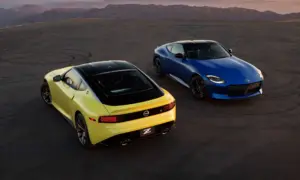
The clearest technical picture points to rear-wheel drive and a version of Nissan’s VR30DDTT 3.0-litre twin-turbo V6. That engine is already familiar from the Nissan Z and the outgoing Infiniti Q50 Red Sport, making it the obvious starting point for a new performance sedan.
Power remains unconfirmed, but the signs point towards something healthy. The current Z Nismo makes 420 hp and 384 lb ft, and the Infiniti sedan could arrive with a stronger tune, possibly beyond 400 hp. That would put it into the sort of territory where the car becomes a serious driver’s machine rather than just a badge exercise.
The gearbox question is even more interesting. Reports around the Infiniti version keep mentioning a manual option, which would be a proper statement in a market that has been steadily erasing engagement from performance cars. Nissan’s own 2026 Z Nismo is automatic only, while the next model year is said to be moving towards a manual Nismo variant. That tells you the company is willing to shift, but not yet in a simple, one-size-fits-all way.

Infiniti needs this more than Nissan admits
The Skyline is not only about the home market. Nissan has said Infiniti will get a performance-oriented V6 sedan as part of its revival, and the obvious reading is that this is the same car in a different suit for North America. Industry reporting has linked it to the next Skyline and even floated a return of the Q50 badge.
That would be a sharp change of direction for Infiniti, which has leaned hard into SUVs while its sedan identity faded into the background. A rear-drive V6 saloon, especially one with a manual gearbox, would drag the brand back toward the kind of buyer who still cares about steering feel, throttle response and whether the gearbox is any good in traffic.
The design approach seems sensible too. Nissan’s leadership has reportedly said the new car is inspired by the past without copying an old Skyline outright. That is the right call. Too much retro and you end up with a costume. Too little and the badge feels pasted on. The teaser silhouette and rear lighting suggest Nissan understands the balance.
Why South African petrolheads should care
There is no confirmed South African relevance yet. Nissan South Africa has not announced the new Skyline for this market, and Infiniti no longer operates here as a normal new-car brand. Any claim of local availability would be pure wish-casting.
Even so, the car still matters to South African enthusiasts. Our own performance sedan market has been squeezed hard by SUVs and crossovers, especially in the premium space, and that has made cars like this feel almost extinct. A new Skyline, or an Infiniti cousin, would be a reminder that there is still room in the world for a proper sports sedan with a bonnet, a boot and a point of view.
It also arrives at a difficult moment for Nissan. The company is in the middle of a painful restructuring under Re, with cost cuts, factory consolidation and workforce reductions all part of the package. Against that backdrop, a car like this has to do more than sell a few units. It has to sharpen perception, restore confidence and make people believe Nissan still knows how to build something desirable.
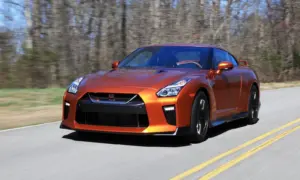
The GT-R comparison will follow it everywhere, but the two cars are separate. The Skyline is not replacing the R35, which ended production in 2025 after an 18-year run. Nissan has said a future GT-R will be reimagined, which leaves the Skyline free to occupy its own space.
A rear-drive Skyline with a twin-turbo V6 and maybe a manual gearbox does not need to be a supercar killer. It just needs to feel alive, look right and arrive on time. If Nissan pulls that off, the car will be more than a new model. It will be the clearest proof that the company’s reset is real.
![Driving The Legendary and Fearsome Spa-Francorchamps [w/video]](https://doubleapex.co.za/wp-content/uploads/SM-at-Raidillon-1-300x180.webp)

![Nissan Patrol Nismo Edition Debuts [w/video]](https://doubleapex.co.za/wp-content/uploads/2021/04/Nissan-Patrol-Nismo-Edition-300x180.webp)
![Nissan GT-R X 2050 Is The GT-R Of The Future [w/video]](https://doubleapex.co.za/wp-content/uploads/2020/12/Nissan-GT-R-X-2050-300x180.webp)
![Nissan Z Proto Unveiled As Z-car Precursor [w/video]](https://doubleapex.co.za/wp-content/uploads/Nissan-Z-Proto-Unveiled-300x180.webp)
![Nissan GT-R50 Production Version Debuts [w/video]](https://doubleapex.co.za/wp-content/uploads/Nissan-GT-R50-production-version-1-300x180.webp)
Have your say
Got thoughts on this?
No feedback yet on Why The New Nissan Skyline Is Crucial To The Brand’s…. Kick the conversation off.
Free. Email link only — no password.