
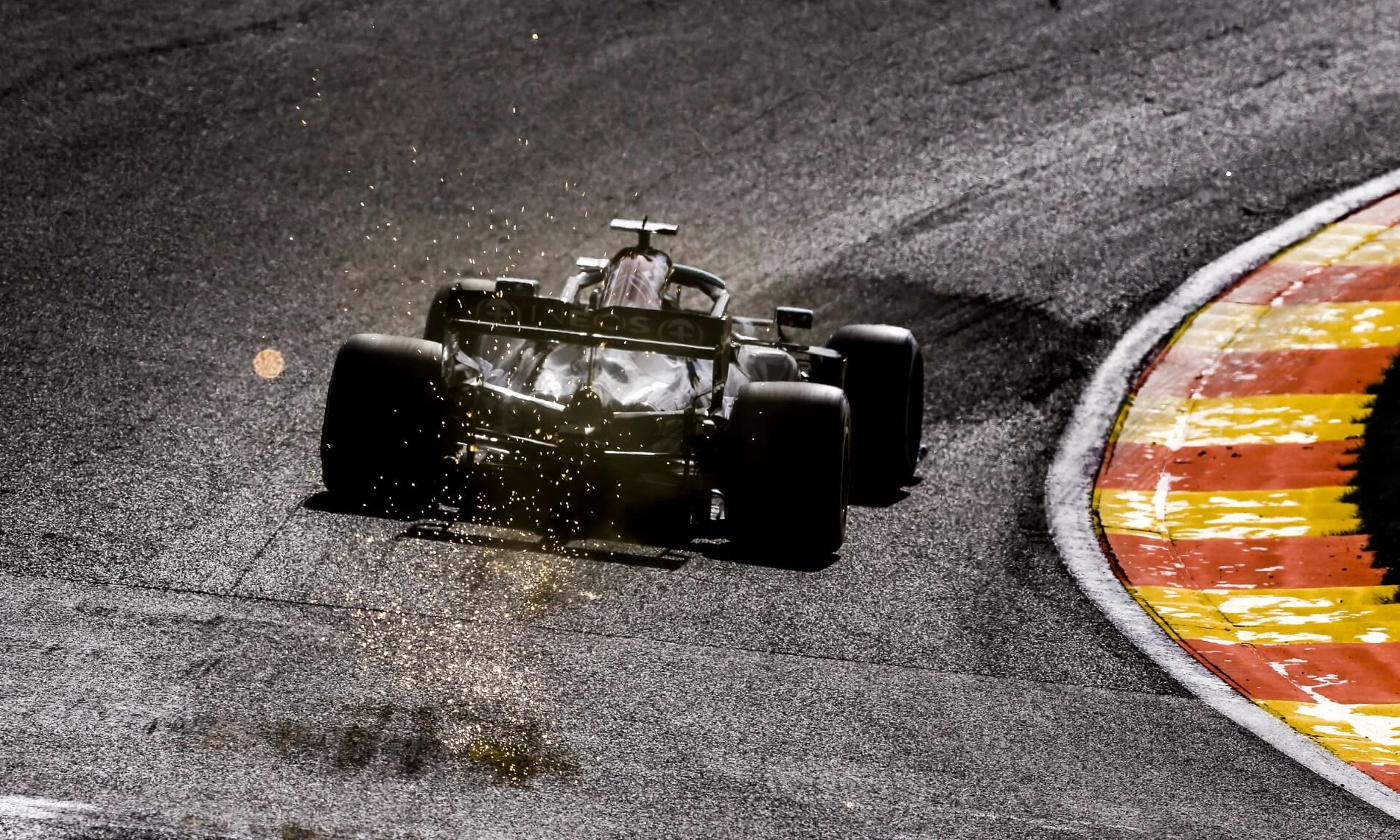
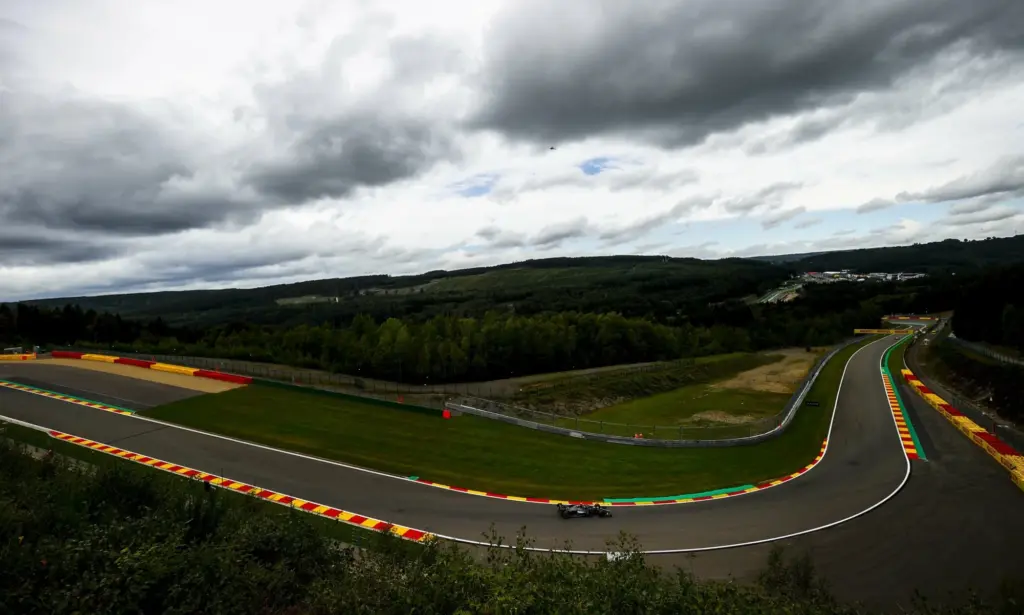
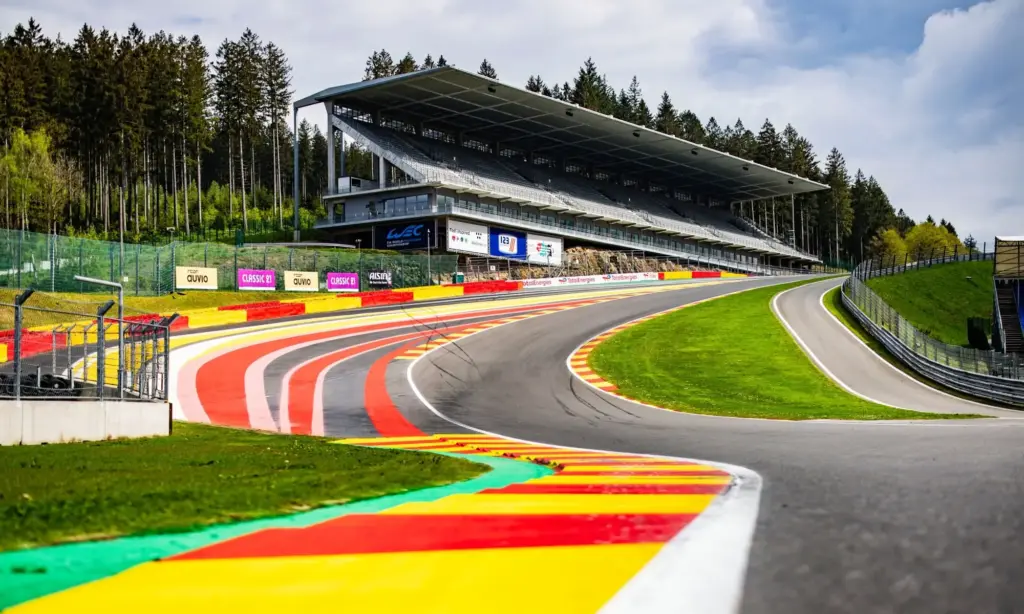

Spa-Francorchamps exposes any weakness a Formula 1 car tries to hide. One lap here asks for a low-drag setup on the Kemmel Straight, then punishes that same car with high-speed commitment through Eau Rouge, Raidillon, Pouhon, and Blanchimont. The 2026 Belgian Grand Prix arrives with extra intrigue because the FIA’s new active aero rules have added more straight mode zones to one of the calendar’s fastest and most unforgiving circuits.
This should make Spa quicker in a straight line and possibly messier everywhere else. More activation zones mean more chances to attack, defend, and for a team to get the compromise wrong. By the time the field reaches the Ardennes, the championship picture is already tight enough to make every point look expensive.
Spa day
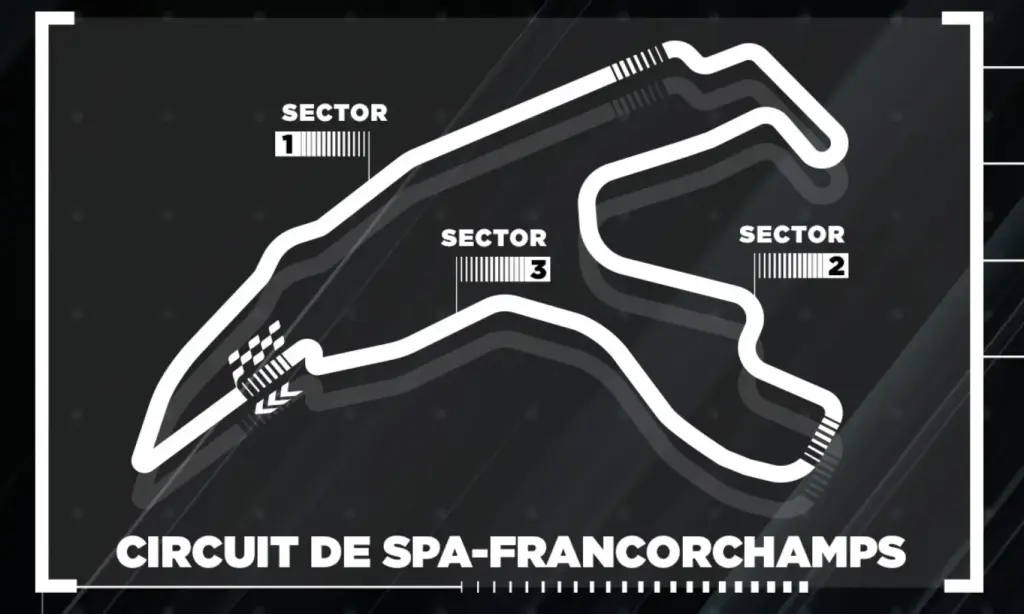
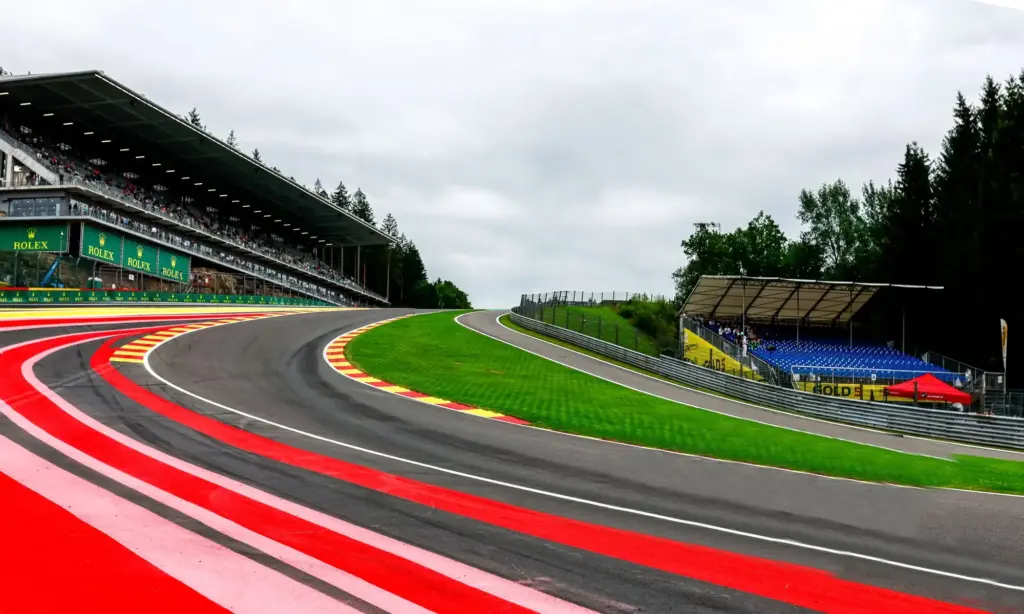
Spa is one of the longest circuits on the F1 calendar at 7,004 kilometres, and it earns every centimetre of that length. The lap climbs and drops more than 100 metres, with the most famous rise coming through the world-famous Eau Rouge and Raidillon, where the track surges uphill by over 40 metres in seconds. Cars arrive there at full tilt, loaded up on aero, tyres working hard, drivers committed far earlier than most mortals would.
The weather also plays a role. The Ardennes can split into neat pockets of wet and dry tarmac, sometimes on the same lap. This turns tyre calls into gambles and often turns clean races into survival exercises. Remember that horrible shunt between Schumacher and Coulthard, which left the former fuming?
A cloud burst over one sector can leave another completely dry, which is how Spa keeps producing afternoons where the strategy wall looks clever for one stint and foolish by the next. If it rains hard enough, we could even have a safety-car parade that robs fans of a spectacle, but is enough to be considered a full race without being considered ‘abandoned’.
The layout demands a rare setup balance. Teams want drag stripped out for the long full-throttle sections, especially Kemmel, but they still need enough downforce and stability for the fast cornering load through Pouhon, the commitment required at Blanchimont, and the traction and braking phase into the Bus Stop chicane. Get the balance wrong, and the car can either get eaten alive on the straights or turns into a nervous compromise in the corners.
Click here to read and watch our very own lap of the famous F1 circuit.
Straight modes galore
From the start of 2026 F1 rules allow for active aero, with the cars switching between a high-downforce cornering setting and a low-drag ‘straight mode’. Spa is exactly the sort of place where that system will be under the microscope. This should make on-track battles more elastic.
In Belgium, there are five designated straight mode zones, beginning with the short run down the start/finish straight, then between Turns 2 and 3, between Turns 4 and 5 (known as the Kemmel Straight), between Turns 15 and 16, and finally between Turns 17 and 18.
A driver who exits the T1 hairpin ‘La Source’ well can now build speed for several phases of the lap. A car that closes up through the technical middle sector can use the extra zones to convert pressure into an actual pass.

Energy deployment will matter more as well. Drivers will need to manage their battery state, activation timing, and throttle application with precision. The advantage from straight mode depends on having the right electrical and power unit delivery at the right moment. A sloppy deployment plan could make a car look quick on paper but ordinary on track if the driver isn’t on his game.
Energy management will be one of the defining factors at Spa, with the circuit’s long full-throttle sections expected to expose the limits of the new 2026 power units more than almost any other track. Empty your battery in defense up the long straight and you’ll be exposed for the rest of the lap. Initial predictions indicate that the cars will be running in a reduced power (ie flat battery state) state for at least 45-50 seconds of the lap. That will severely reduce lap times.
The title fight
The early season has already given the title race a shape. Antonelli has been the standout performer, showing pace and control that belies his age. Lewis Hamilton’s win in Spain was of great relief, for him, and the Tifosi, showing the seven-time champ still has what it takes. Leclerc’s Silverstone result was built on timing and composure, which is exactly the kind of form that keeps Ferrari in the fight.
Despite recent retirements and car issues, Kimi Antonelli still leads the Drivers’ Championship. He will be aiming to add to his win tally going into the summer break. His Mercedes teammate, George Russell lies second having taking a pair of wins to his teenage teammate’s five.
A decent run of form has seen Ferrari pair of Lewis Hamilton and Charles Leclerc take over third and fourth. The red cars being the only ones, beside Mercedes, to win this year, with one apiece for each of the pilots. Hamilton proving to be the closest to challenging the Silver Arrows to the title. In both teams the less dominant teammate will be aiming to rack up a decent result that sends them into the summer break on a high.
Who should be there at the end?
Spa should favor the usual suspects, but not in the same way. Spa has always suited drivers who are quick, bold, and unbothered by risk. The Mercs have been the class of the field, delivering multiple wins for bother drivers. They should be the odds-on favourite to occupy the podium spots.
Title defending McLaren and Red Bull Racing are both not quite on the pace of the Silver and Red cars. Any pace deficiency both teams have experienced will only be highlighted at a circuit that relies on aero efficiency and a strong powerplant. Don’t expect a serious challenge unless, perhaps, it turns out to be a rain-soaked affair.

![F1 Drivers Pilot Aston Martin Valkyrie At Silverstone [video]](https://doubleapex.co.za/wp-content/uploads/Valkyrie-At-Silverstone-300x180.webp)
![Monaco F1 Grand Prix [w/videos]](https://doubleapex.co.za/wp-content/uploads/Monaco-F1-Grand-Prix-300x180.webp)


Have your say
Got thoughts on this?
No feedback yet on Spa-Francorchamps Readies for a 2026 F1 Season of New Challenges. Kick the conversation off.
Free. Email link only — no password.