
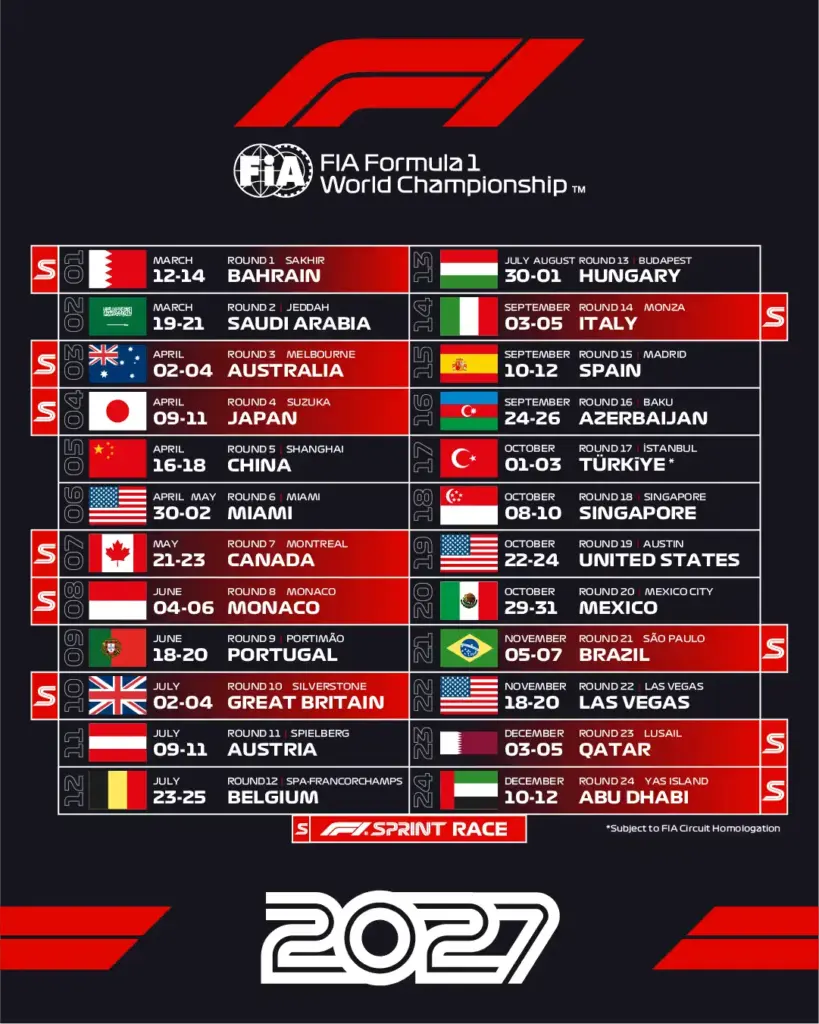


The World Motor Sport Council and Formula One have unveiled the 2027 calendar. Twenty-four races, ten Sprints, and two circuits that haven’t seen F1 machinery in years: the 2027 calendar is the most aggressive expansion of the modern championship era. The WMSC has approved a schedule that stretches from Bahrain in late February to Abu Dhabi in December. The 2027 season threads five continents (still no African race) through 22 countries with what the sport calls “geographical efficiency”.
The Return of Portugal and Turkey
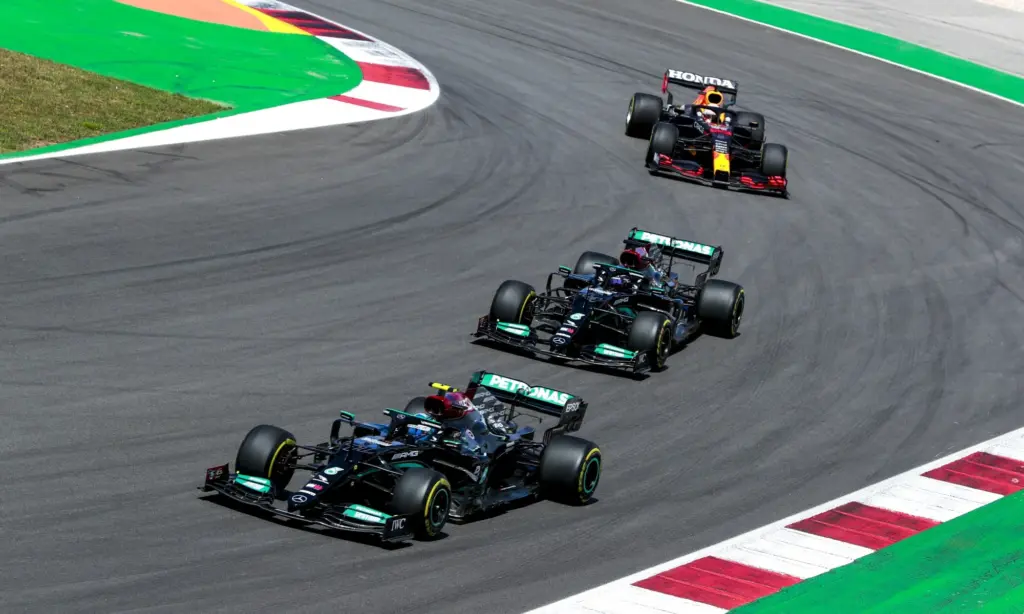
Portugal last hosted a Grand Prix at Portimao in 2021. The circuit on the Algarve played stand-in during the pandemic-era and produced one of the most chaotic wet-dry races in recent memory. It returns in June 2027, slotted immediately after Monaco, keeping the European season tightly clustered. Teams will make a short hop from the Mediterranean to the Portugal rather than the intercontinental shuttles that have broken up recent European legs.
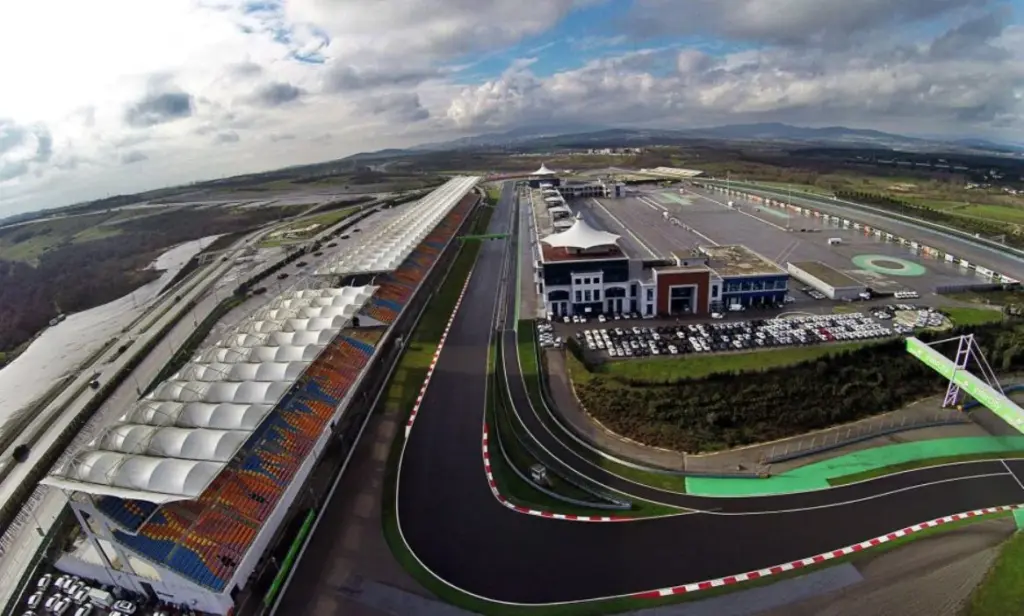
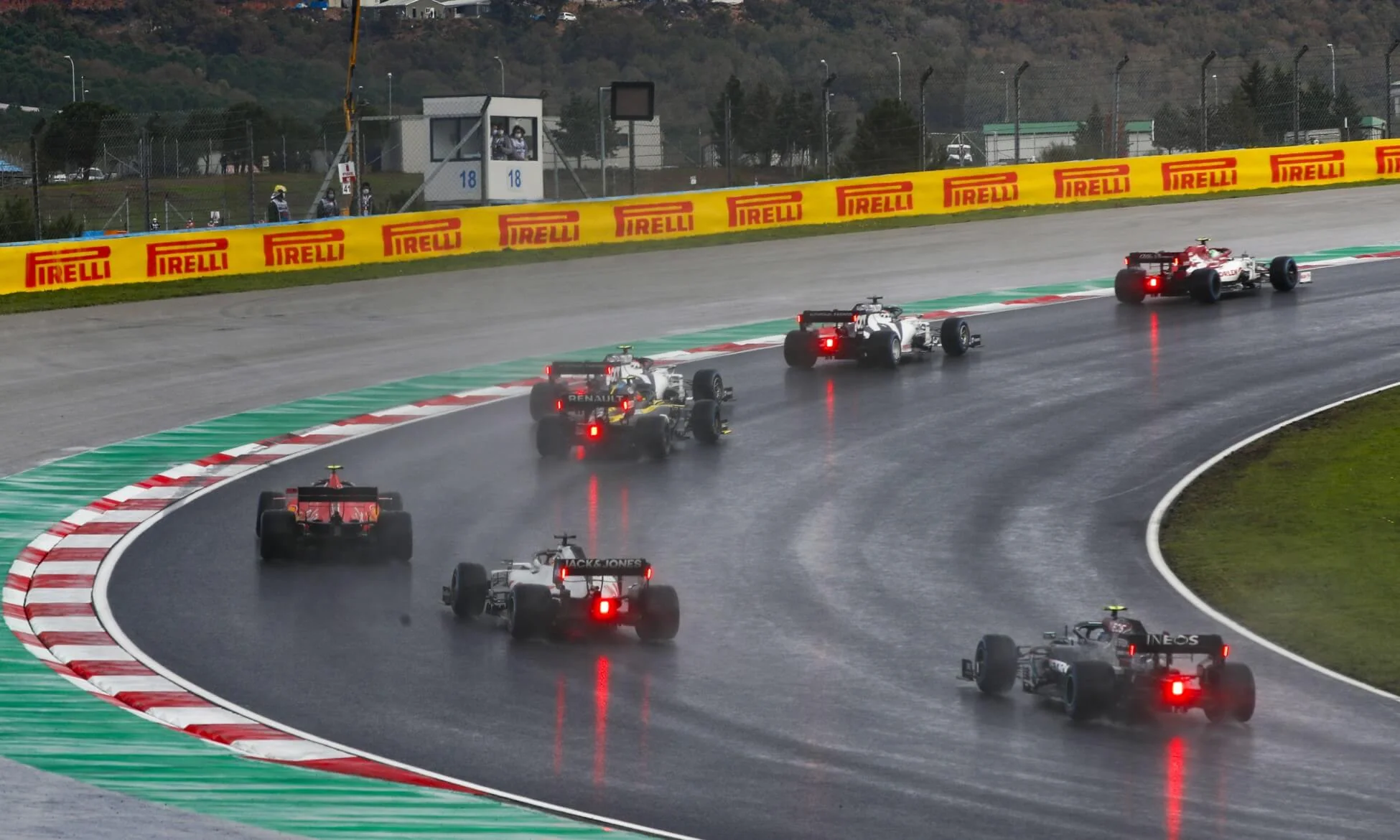
Turkey’s return is a bit more of a surprise. Istanbul Park produced classics in its brief 2020-2021 cameo, including a race where Lance Stroll started on pole in wet conditions and Hamilton clinched his seventh title in a treacherous, resurfaced nightmare. The track’s multi-apex Turn 8, taken flat in modern machinery, remains one of the most demanding corners on any calendar. In 2027 it sits between Azerbaijan and Singapore in October, creating a Middle Eastern and Asian leg that keeps freight pointed eastward rather than bouncing teams back to European bases between races.
Pre-season testing runs 24–27 February in Bahrain, which then hosts the season-opening race. The four-day test at the race venue, rather than Barcelona, continues a recent trend that reduces freight movements. From there the calendar moves through Saudi Arabia, Australia, Japan, China, Miami, and Canada before the European leg begins. The American excursion clusters Austin, Mexico City, and Sao Paulo before the final desert rounds in Las Vegas, Qatar, and Abu Dhabi.
Ten Sprints and the Data Behind the Push
The Sprint format expands from six events to ten in 2027. Since 2021, Sprint weekends have generated total viewership 12 per cent above standard Grand Prix weekends. Sprint Qualifying sessions draw up to triple the audience of Free Practice. Attendees report that the format adds value to their ticket purchase. Three-quarters of surveyed fans believe Sprints enhance the calendar’s overall worth.
New Sprint hosts for 2027 are Bahrain, Australia, Japan, Monaco, and Abu Dhabi. Bahrain as the season opener with a Sprint means teams must arrive with race-ready set-ups after four days of testing at the same circuit, eliminating the usual gap between testing and competition.
Monaco’s inclusion is the most radical departure. The principality will host two separate qualifying sessions, one for the Sprint and one for the Grand Prix, on a circuit where qualifying position determines race outcome more absolutely than anywhere else. The historical objection to Sprinting at Monaco, that overtaking is functionally impossible, is answered not by changing the circuit but by doubling the stakes of Saturday positioning.

Returning Sprint venues, Montreal, Silverstone, Monza, Sao Paulo, and Lusail, maintain continuity. Abu Dhabi closes both the Sprint roster and the season, hopefully adding championship-deciding tension to the season-closer.
The Physical and Strategic Toll
Twenty-four Grands Prix plus ten Sprints equals 34 points-scoring sessions across a season that runs ten months. For teams, the manufacturing and logistics cycles face unprecedented pressure. Power unit allocations, already restricted, must survive more competitive kilometres. Crash damage probability increases with more races and less practice time to refine setups before competitive running. The championship may swing less on raw pace than on which organisation can maintain reliability and personnel freshness through the final quarter.
The calendar’s claimed geographical efficiency, grouping races regionally to reduce freight movement, is presented as a sustainability measure. Whether this survives the commercial demands of broadcast scheduling and local promoter preferences remains to be seen. The theory is sound: fewer transcontinental flights, shorter sea freight routes all help to reduce F1’s carbon footprint. The practice of moving hundreds of tons of equipment across 22 countries will test that theory.
From the Boss
Stefano Domenicali, president and CEO of Formula 1, said: “The 2027 calendar brings together some of the most iconic circuits and vibrant cities in the world, creating an incredible stage for another unforgettable season of Formula 1. We are thrilled to welcome Portugal and Türkiye to the championship and to expand Sprint racing to ten events, giving our fans even more intensity, drama, and the wheel-to-wheel action that make our sport so special. We are incredibly excited to see this calendar come to life and to deliver another season packed with unforgettable moments, fierce competition, and world-class entertainment for our fans across the globe.”
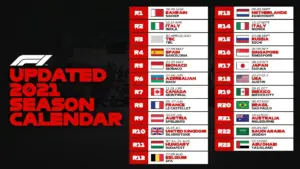
Calendar image from Formula One
![2023 Formula One Cars [Gallery]](https://doubleapex.co.za/wp-content/uploads/2023/02/Mercedes_AMG_F1_W14_E_PERFORMANCE_4-300x180.webp)






![2021 Formula One Cars [Gallery]](https://doubleapex.co.za/wp-content/uploads/2021/03/Ferrari-SF21-front-300x180.webp)

Have your say
Got thoughts on this?
No feedback yet on 2027 F1 Calendar Expands With Returns And Ten Sprint Races. Kick the conversation off.
Free. Email link only — no password.